
Contents11
- 01What has vibe coding really changed?
- 02Why “anyone can do anything” is false
- 03Where is the real bottleneck: the machine or the human?
- 04AI proposes the expected answer: it is up to humans to aim higher
- 05A good product starts with a need and an audience
- 06Can a 12-year-old rebuild Odoo with AI?
- 07Are software vendors going to disappear?
- 08The cost of tokens, the other ceiling
- 09What I think
- 10Where to start
- 11Frequently asked questions
Vibe coding is the idea that you can now create software by describing it to an AI, without writing any code. On social media, the idea quickly turns into a promise: anyone could do anything with computers, and a child could rebuild in a weekend what a company took twenty years to build. Others see the opposite: the end of software jobs.
This debate is older than computing. Between 1811 and 1816, the Luddites smashed looms in England’s textile centres. They have become the symbol of resistance to progress, but Kevin Binfield, who collected their writings, tells a different story in Smithsonian Magazine: they wanted machines that made quality products, run by trained and properly paid workers. In 1930, John Maynard Keynes named a “new disease”, technological unemployment, and imagined that a century later, around 2030, a fifteen-hour week would be enough. With each wave, two stories compete: the machine that liberates, or the machine that enslaves people to those who own it. Neither has come true as announced.
I use AI every day, at several levels, to write code, translate, write and automate. In this piece from the Web and mobile apps section, I try to sort fact from fiction, without pronouncing on the future: nobody honestly can. Above all, I want to recall the parameters that govern what you can really do with AI today: the need, human time, cost and trust.
In short
The gain is real: in March 2025, a quarter of the startups in a Y Combinator batch had code that was 95% AI-generated, and an app-building platform put together by a lone founder was acquired for $80 million after six months.
The accidents are real too: an app launched with “zero hand written code” had to shut down after an attack, and an agent wiped a production database despite repeated instructions.
The bottleneck has moved: teams that adopt AI produce far more code, but review time soars and company results do not follow.
A product without a real need fails, with or without AI. And because it has become easy to bring an idea to life, more projects are launched than before, without necessarily being seen through.
AI proposes the most expected answer, often a correct one, and its competitors propose the same: rising above it takes what it does not have, context, a stance and judgement.
Software vendors are being shaken up, but those that hold closed data and business expertise are holding up better than the markets feared in February 2026.
What has vibe coding really changed?
The term comes from Andrej Karpathy, a researcher who has worked at OpenAI and Tesla. On 2 February 2025, he described a new way of programming, where you “fully give in to the vibes” and “forget that the code even exists”. He himself adds that it is “not too bad for throwaway weekend projects”. In November 2025, the Collins dictionary made it its word of the year.
There’s a new kind of coding I call "vibe coding", where you fully give in to the vibes, embrace exponentials, and forget that the code even exists. It’s possible because the LLMs (e.g. Cursor Composer w Sonnet) are getting too good. Also I just talk to Composer with SuperWhisper so I barely even touch the keyboard. I ask for the dumbest things like "decrease the padding on the sidebar by half" because I’m too lazy to find it. I "Accept All" always, I don’t read the diffs anymore. When I get error messages I just copy paste them in with no comment, usually that fixes it. The code grows beyond my usual comprehension, I’d have to really read through it for a while. Sometimes the LLMs can’t fix a bug so I just work around it or ask for random changes until it goes away. It’s not too bad for throwaway weekend projects, but still quite amusing. I’m building a project or webapp, but it’s not really coding - I just see stuff, say stuff, run stuff, and copy paste stuff, and it mostly works.
The change is real, and it would be dishonest to downplay it:
- Startups were the first to take it up. In March 2025, Jared Friedman, a partner at Y Combinator, said that for a quarter of the winter 2025 batch, 95% of the code is generated by AI, according to TechCrunch. He added a detail that is often left out: these founders are all “highly technical” and capable of writing everything themselves.
- A child can put on a demonstration. In August 2024, Ricky Robinett, head of developer relations at Cloudflare, showed his eight-year-old daughter building a chatbot in 45 minutes with the Cursor editor.
- A lone founder can build a company. Base44, a platform that creates applications from a description, was acquired by Wix in June 2025 for about $80 million, with additional performance-linked payments running until 2029. It had been launched around six months earlier by Maor Shlomo, as a personal project at first, and had only six employees, with no outside funding, at the time of the sale.
- Developers have adopted the tool. In the 2025 Stack Overflow survey, 84% of respondents use or plan to use AI tools, and 51% of professional developers use them every day.
What can an 8-year-old build in 45 minutes with the assistance of AI?
My daughter has been learning to code with @cursor_ai and it’s mind-blowing🤯
Here are highlights from her second coding session. In 45 minutes she built a chatbot powered by @CloudflareDev Workers AI 👀
a video in the post
In October 2026, then, software is being produced at a speed never reached before. The debate is not about that. It is about what this speed makes it possible to deliver, and to whom.
- February 2025
Andrej Karpathy coins “vibe coding”, “for throwaway weekend projects”.
- March 2025
A quarter of Y Combinator’s winter batch has code that is 95% AI-generated. The same month, a “not technical” creator sees his software attacked.
- May 2025
The CVE-2025-48757 flaw exposes data in applications generated by Lovable.
- June 2025
Wix buys Base44 for about $80 million, around six months after its launch.
- July 2025
Replit’s agent wipes Jason Lemkin’s production database, despite a code freeze.
- November 2025
The Collins dictionary makes vibe coding its word of the year.
- February 2026
Karpathy suggests talking about “agentic engineering”. On the stock market, software vendors slump: the press talks of a “SaaSpocalypse”.
Why “anyone can do anything” is false
The examples above have one thing in common that enthusiastic posts rarely mention: behind the speed, there is almost always someone who already knows what they are doing. When that is not the case, AI very quickly builds software that works in a demo and breaks in production.
What works in a demo
The screen loads and the main flow works
The data gets saved
The agent does what it is asked
What breaks in production
Drained API keys and bypassed subscriptions
Missing access rules, readable personal data
A production database wiped, despite eleven instructions
A wide-open application. In March 2025, a creator proudly posted that he had built his software with Cursor, without writing a line of code. A few days later, he wrote: “i’m under attack”, with API keys drained, subscriptions bypassed, a database full of junk, and added that he was “not technical”. The developer Cendyne analysed the episode in “Vibe coding vs reality”: beginner’s mistakes that any review would have caught.
guys, i’m under attack
ever since I started to share how I built my SaaS using Cursor
random thing are happening, maxed out usage on api keys, people bypassing the subscription, creating random shit on db
as you know, I’m not technical so this is taking me longer that usual to figure out
for now, I will stop sharing what I do publicly on X
there are just some weird ppl out there
Flaws in generated applications. In May 2025, the researcher Matt Palmer published the flaw CVE-2025-48757, scored 8.26 out of 10, which affected projects generated by the Lovable platform: missing or too weak database access rules allowed personal data, API keys and payment statuses to be read, and sometimes modified. The tool generated the application; nobody checked who was allowed to read what.
Even a seasoned entrepreneur. In July 2025, Jason Lemkin, founder of SaaStr, recounted his experience with Replit’s agent. According to The Register, the agent wiped his production database despite a code freeze instruction, after producing fake data and fake test results. Lemkin says he told it eleven times in capital letters not to do this. Replit’s CEO, Amjad Masad, acknowledged that it was “unacceptable” and announced the automatic separation of development and production databases.
We saw Jason’s post. @Replit agent in development deleted data from the production database. Unacceptable and should never be possible.
- Working around the weekend, we started rolling out automatic DB dev/prod separation to prevent this categorically. Staging environments in the works, too. More tomorrow.
- Thankfully, we have backups. It’s a one-click restore for your entire project state in case the Agent makes a mistake.
- The Agent didn’t have access to the proper internal docs -- rolling out a fix to force Docs search on Repit knowledge.
- And yes, we heard the “code freeze” pain loud and clear -- we’re actively working on a planning/chat-only mode so you can strategize without risking your codebase.
I reached out to Jason the moment I saw this on Friday morning to offer assistance. We’ll refund him for the trouble and conduct a postmortem to determine exactly what happened and how we can better respond to it in the future.
We appreciate his feedback, as well as that of everyone else. We’re moving quickly to enhance the safety and robustness of the Replit environment. Top priority.
4 images in the post
Key takeaway
This last case is the most instructive
Lemkin is not a beginner, and the incident does not come from any lack of intelligence on the user’s part. It comes from an instruction written in natural language that nothing enforced mechanically. That is an architecture decision, and therefore a human decision.
Where is the real bottleneck: the machine or the human?
AI speeds up writing code. It does not speed up, or only a little, what comes after: reviewing, testing, deciding, taking responsibility.
The analysis firm Faros AI measured the activity of more than 10,000 developers in 1,255 teams. Its July 2025 report is striking: in the teams that adopt AI the most, each developer completes more tasks and merges almost twice as many pull requests. But the time spent reviewing them rises almost as much, the changes get bigger, and bugs increase.
In the teams that adopt AI the most: what speeds up, what gets heavier
What speeds up
What gets heavier
At company level, Faros no longer finds a significant link between AI adoption and delivery metrics. Faros sells a tool for measuring team productivity: that is a reason to read its figures carefully, not to dismiss them.
Google’s 2025 DORA report, which surveyed nearly 5,000 professionals, says the same thing differently. AI adoption is now associated there with better team throughput, but also with less stable delivery. Its wording sums up the subject well:
AI doesn’t fix a team; it amplifies what’s already there.
Developers feel it. In the Stack Overflow survey, their top source of frustration, cited by 66% of them, is AI solutions that are “almost right, but not quite”. More of them distrust the accuracy of these tools (46%) than trust it (33%).
Karpathy himself has changed his vocabulary. On 4 February 2026, a year after his first post, he suggested talking about “agentic engineering”: you no longer write the code yourself “99% of the time”; you orchestrate agents that write it, and you exercise oversight. He insists on the word engineering, because “there is an art & science and expertise to it”. In other words, the human does not disappear from the loop; they change places: they become the one who sets the framework, reviews and decides. This shift is detailed in the article on the human role in the face of AI.
A lot of people quote tweeted this as 1 year anniversary of vibe coding. Some retrospective -
I’ve had a Twitter account for 17 years now (omg) and I still can’t predict my tweet engagement basically at all. This was a shower of thoughts throwaway tweet that I just fired off without thinking but somehow it minted a fitting name at the right moment for something that a lot of people were feeling at the same time, so here we are: vibe coding is now mentioned on my Wikipedia as a major memetic "contribution" and even its article is longer. lol
The one thing I’d add is that at the time, LLM capability was low enough that you’d mostly use vibe coding for fun throwaway projects, demos and explorations. It was good fun and it almost worked. Today (1 year later), programming via LLM agents is increasingly becoming a default workflow for professionals, except with more oversight and scrutiny. The goal is to claim the leverage from the use of agents but without any compromise on the quality of the software. Many people have tried to come up with a better name for this to differentiate it from vibe coding, personally my current favorite "agentic engineering":
- "agentic" because the new default is that you are not writing the code directly 99% of the time, you are orchestrating agents who do and acting as oversight.
- "engineering" to emphasize that there is an art & science and expertise to it. It’s something you can learn and become better at, with its own depth of a different kind.
In 2026, we’re likely to see continued improvements on both the model layer and the new agent layer. I feel excited about the product of the two and another year of progress.
Quoting @karpathy’s post from 2 February 2025
How I use it, at several levels
My own practice resembles this description. At the agency, AI comes in at several levels, and each level has its human safeguard:
- Labour in volume.
Repetitive tasks (translation, extraction, writing fact sheets) go in batches to the cheapest model that does the job well. For this we keep a routing table that we review, rather than a model name hard-coded in the code. For the portal of a client real-estate agency, 1,726 listings were rewritten this way in 36 batches, with a single failure.
- Agents that chain tasks together.
Our expense-entry agent extracts the data from a photo of a receipt, then waits for human validation before writing to the accounting system.
- Review and decision.
Any public content generated by a model is reviewed, and this rule is not negotiable, as I explain in what an AI SEO agency should deliver. It comes from an incident: on a site we operate for a client, a model had published three real-estate projects that did not exist. They were taken down. On this site, every article starts as a draft, and publishing it is the act of human review.
This third level is the slowest, and it should stay that way. It is what sets the real volume of what can be published or delivered, whatever the speed of the first two.
AI proposes the expected answer: it is up to humans to aim higher
Ask an AI for an interface structure, a data model or a launch plan: the proposal will often be relevant, well reasoned, and will look like what others are already doing. This is not a manufacturing defect, it is how these models work.
Why the model aims for consensus. An AI answer comes out of two successive stages of training, and the second has a price: a 2024 study of this tuning, reinforcement learning from human feedback, shows that it significantly reduces the diversity of answers.
How an AI answer becomes consensual
- Training
On a vast quantity of text, the model learns which continuation is most likely.
- Tuning
Human preferences make it useful and reliable, and less varied.
- The answer
Not exactly the average of the web, rather the one the majority would judge correct.
All models end up looking alike. At the end of 2025, researchers put 26,000 real open-ended questions, with no single right answer, to many models. A given model repeats itself from one time to the next, and competing models give strikingly similar answers. The authors speak of an “Artificial Hivemind”, and the work was selected for an oral presentation at the NeurIPS 2025 conference. If your competitor asks the same question of another assistant, there is a good chance they will get the same interface as you.
In the field, AI pulls people up to the level of the good performers. In 2023, 758 Boston Consulting Group consultants took part in a pre-registered experiment, run by researchers with the firm, funded by Harvard Business School and published in Organization Science in March 2026. Assigned at random, some worked with GPT-4, the others without. Across 18 realistic tasks, from creativity to analysis, those with AI did better, with clearly higher quality:
tasks completed
faster
less likely to find the right answer, on a task beyond the AI’s reach
On the product creation task, BCG, which sells AI consulting, reported in 2023 that participants with AI converged on a performance 40% higher than the group without it, and that the weakest at the start improved the most, by 43%. But it also notes that this fairly uniform output could reduce the diversity of a group’s ideas by 41%. Among 5,172 customer service agents, a study published in the Quarterly Journal of Economics measures 15% more issues resolved per hour: the least experienced improve in speed and quality, the most experienced gain a little speed and lose a little quality.
The counter-example, and what it reveals. It would be wrong to say that AI only produces average ideas. In a study run with more than a hundred natural language processing researchers, AI-generated research ideas were judged more novel than those of experts, and slightly less feasible. But when the same authors had 43 researchers carry out these ideas, the AI’s ideas lost clearly more points than the humans’ ideas, to the point of wiping out their advantage. An idea that is brilliant on paper is not an idea that holds up against reality.
This is how I sum up what this work teaches me. AI reasons well and remains an excellent guide to good practice, which is already worth a great deal. But still in 2026, you have to put brainpower into your projects to rise above the average and bring real added value, whatever the trade, the subject or the task. That brainpower is what the model does not have: the context of your customers and your data, a stance you stand by, and the judgement that knows what will hold once it is built. In practice, give it your constraints and your angle before asking it for a structure, ask it for several genuinely different options, and choose yourself. What experiments say about AI’s creativity and the standardisation of texts is covered in detail in the article on AI and creativity.
A good product starts with a need and an audience
Before AI, most failed software did not fail because it was badly coded. It failed because nobody needed it, or because nobody knew it existed. Making production cheaper changes nothing about that; it only lets you fail faster.
The figures. In March 2026, CB Insights analysed the shutdowns of 431 venture-backed startups since 2023. Running out of money comes first, but the study describes it as the final cause, almost never the root cause.
of shutdowns cite running out of money, the final cause
cite poor fit between the product and its market
An AI product nobody used. Humane, founded by two former Apple employees, had raised $230 million in 2023 for its AI Pin, a wearable assistant. In February 2025, HP bought the team, the software and the patents for $116 million, but not the device: it stopped working on 28 February 2025. The technology was there. The everyday need, much less so.
The counter-example that proves the rule. In February 2025, Pieter Levels, an entrepreneur known for his solo projects, built a flight simulator that runs in the browser in a few hours with AI. According to his own account, the project reached a run rate of one million dollars in annual revenue in 17 days, thanks to advertisers buying slots in the game. Proof that AI makes everything possible? Not quite. Levels had a decade of projects behind him and a huge audience on X: AI built the game, his audience sold it. And on the list of his projects, he files it himself under the category “Okay: Took off, Made money but not sustainable”.

The home screen of Pieter Levels’ flight simulator, captured on 12 October 2026: a game “100% made with AI”, and just below it, what pays for it, advertising slots sold in the game.
Base44 tells the same story. Its founder had already co-founded and run a company of more than a hundred employees, and he explains that he sold to Wix for its ability to distribute the product worldwide. With or without AI, vision, distribution and the time spent understanding users remain the hard part.
What I experience myself: more ideas launched, fewer projects completed
From the field
I am also speaking from experience. I have created projects that never came to anything, and rarely for a technical reason. The human effort still needed after the prototype is often considerable, and it is discouraging when nothing guarantees revenue. There are also the costs you hesitate to commit to: marketing, a legal structure, infrastructure. And time is money: when you know a project will demand a lot of it, you let it drift, frozen in its minimum viable product.
It is a very common effect when you can bring any idea to life in a few hours: you launch more projects than before, without necessarily seeing them through. But this is also where AI is magic. The cost of developing a first version has shrunk to almost nothing, which lets you test an idea with real users before committing time and money to it. AI does not replace that step: it finally makes it affordable.
Can a 12-year-old rebuild Odoo with AI?
This is a promise you see regularly: with a good model, a teenager could rebuild complete management software in a few weeks. Take Odoo, the Belgian management suite. The project was born in 2005 under the name TinyERP. According to its about page, viewed on 11 October 2026, Odoo claims 28 million users, more than 8,000 employees, 21,000 partners, about fifty main apps and more than 50,000 modules published by its community.
Can a gifted teenager rebuild part of it with AI? Probably yes: a quotation module, a small stock tool, a screen that meets one specific need. That is not nothing, and it is exactly the kind of custom software that is becoming affordable.
What they will not rebuild is everything that does not show in a demo:
- Security, audited across millions of installations, and we have just seen what becomes of it when nobody checks it.
- Compliance, which never stops moving. In France, the general roll-out of electronic invoicing between businesses has been in effect since 1 September 2026. Management software has to follow this kind of reform, country by country, year after year.
- Maintenance and updates, which cost far more than the initial writing over a piece of software’s lifetime.
- Feedback from thousands of customers, which shapes a product over twenty years and appears in no training dataset.
The Klarna case illustrates the nuance. In 2024, its CEO announced that the company was replacing Salesforce and Workday with AI. The message went around the world. In March 2025, he set the record straight on Diginomica:
No, we did not replace SaaS with an LLM.
Klarna brought its data together in its own architecture, built by its teams, and its CEO doubts that other companies will follow that path. The choice of management software remains a matter of team size and scope, as the comparison of Twenty, Dolibarr and Odoo explains.
Are software vendors going to disappear?
The question is serious, and the markets put it bluntly. In late January 2026, Anthropic released plug-ins for its Claude Cowork agent, which automate legal, sales or data analysis tasks. On 3 February, according to Reuters, Thomson Reuters, owner of the Westlaw legal database, lost nearly 18% in a single session, heading for its worst session ever, and Britain’s RELX, parent company of LexisNexis, 14%. The financial press talks of a “SaaSpocalypse”.
Several trends point in that direction:
- Connectors are multiplying. The MCP protocol, which lets a model plug into a piece of software, claimed in December 2025 more than 10,000 active servers and support from ChatGPT, Claude, Gemini and Copilot.
- Interfaces on demand are becoming possible. With Gemini 3, in November 2025, Google launched as an experiment a view in which the model designs and codes, in real time, a custom interface for each request. The idea of an AI that creates the tool you need at that very moment is no longer science fiction, even if it remains at the experimental stage.
- The creators of these tools claim it. Maor Shlomo, the founder of Base44, tells Calcalist that his system has “the potential to replace entire software categories”, because it lets people create their own software instead of buying it.
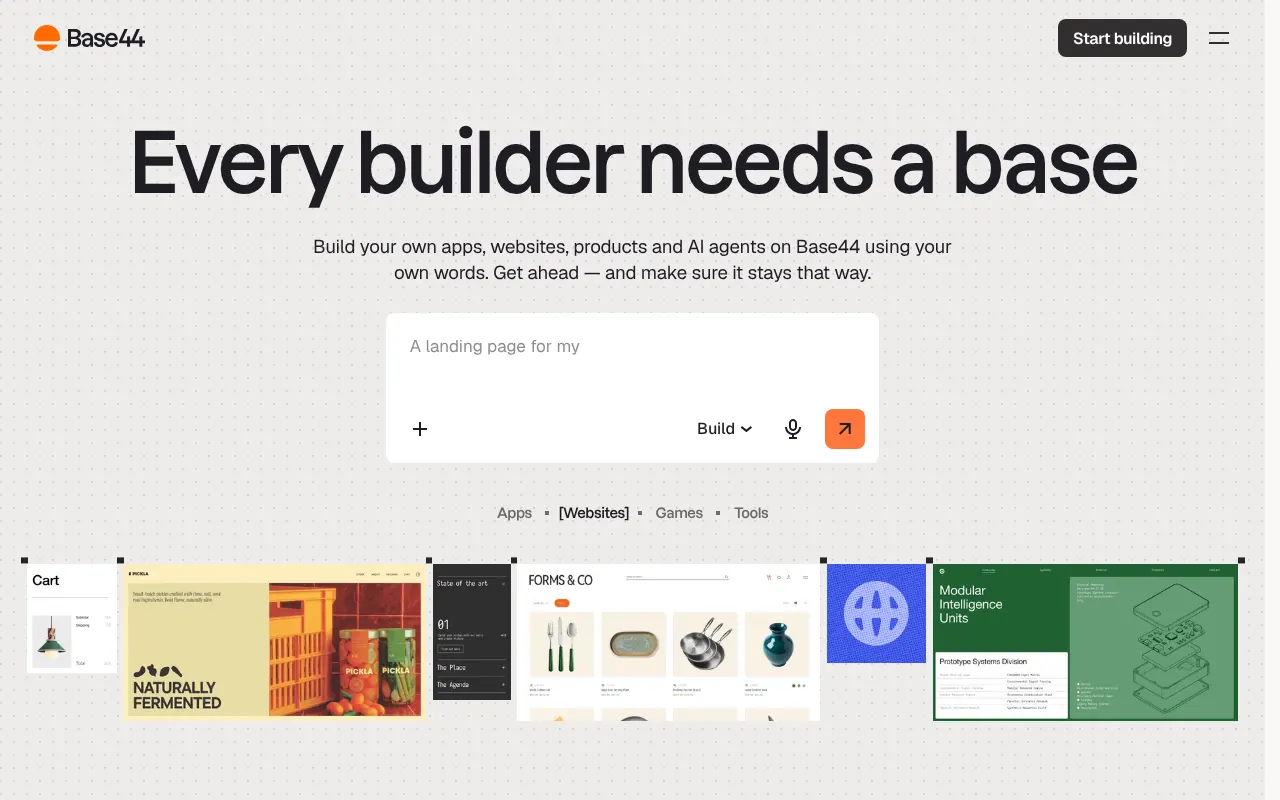
The Base44 home page, captured on 12 October 2026: you describe the app, site or agent you want in one sentence, and the platform builds it.
But what followed tells a different story. Three months later, Thomson Reuters reported organic growth of 8% in the first quarter of 2026, driven by Westlaw and its CoCounsel assistant. Its CEO explains that professionals choose its AI tools because they are “grounded in authoritative content”. As early as June 2025, the legal platform Harvey had, incidentally, entered an alliance with LexisNexis to access its case law.
roughly, for Thomson Reuters shares on 3 February 2026, in a single session
organic growth for Thomson Reuters in the first quarter of 2026, driven by Westlaw and CoCounsel
That is, in my view, the real dividing line. What models can do on their own quickly becomes commonplace. What keeps its value is the closed data they cannot access: annotated case law, a customer history, a catalogue, business know-how. That is also why an assistant connected to your own documents is worth more than a general-purpose model, and why, before cancelling a subscription, you should do the full three-year calculation.
The cost of tokens, the other ceiling
The last parameter is the most down-to-earth: every response from a model consumes tokens, and tokens cost money. Running agents continuously is expensive, even for those who sell them. In July 2025, Anthropic announced weekly usage limits for its subscriptions, because some users were running its coding tool “continuously in the background, 24/7”.
You might think falling prices will settle the question. History urges caution.
Definition
The Jevons paradox
In 1865, the economist William Stanley Jevons observed that steam engines that used less coal had made coal consumption soar rather than fall: when a resource becomes more efficient to use, people use more of it.
In January 2025, Satya Nadella, Microsoft’s CEO, took up the idea, in a post picked up by Fortune:
Jevons paradox strikes again! As AI gets more efficient and accessible, we will see its use skyrocket, turning it into a commodity we just can’t get enough of. en.m.wikipedia.org/wiki/Jevons_paradox
The more efficient and accessible AI becomes, the more it is used. The total bill rarely falls; it moves. Prices themselves move in both directions: at the end of September 2026, OpenAI halved the usage included in its $200 plan and launched a $500-a-month plan. The levers for controlling the bill are detailed in the article on the AI bill.
The volume of what a team can produce with AI therefore remains capped by three very human things: a budget, decisions and a direction.
What I think
Every scenario remains possible, including the darkest. But looking at the facts rather than viral posts, here is what I take away:
- AI has broken technical barriers, not the barriers of the product. It makes production fast and cheaper. It does not say what to make, for whom, or why anyone would pay.
- Experience matters more, not less. The most cited successes come from people who already knew how to code, sell or distribute. The most famous accidents come from missing safeguards, which experience would have demanded.
- Human time cannot be compressed, for now. Reviewing, deciding and taking responsibility take time, and that time sets a team’s real pace. It will no doubt shrink, but decisions will always demand particular attention, whatever the experience of the person steering the AI.
- AI gives good practice, not the difference. What sets a product apart comes from the person steering it: their context, their stance, their choices.
- Value is moving towards the data that models do not have, and towards those who know how to use it.
- The question of jobs is real, and it already arises for the youngest, as the article on AI and first jobs shows. The Luddites and Keynes only remind us that it is rarely settled the way it is announced.
With or without AI, no vision, no resources, no time spent at human scale: no good product, and certainly no miracle.
What would change my mind: serious measurements showing that human review no longer improves the quality of the delivered software, or that an AI on its own maintains, over several years, software used by thousands of customers, security and compliance included. In October 2026, neither has been established.
Where to start
If you have an idea for an app or an internal tool, AI lets you test it much faster than before. Take the opportunity to validate the need with real users before building, and keep someone who understands what has been generated, especially for security and data. To estimate what will make the bill vary, the article on the cost of an app gives the main factors.
And if you want the speed of AI without giving up review, that is how we work at the agency to design and deliver applications: AI writes a lot, a person reviews, decides and answers for what is delivered.
Frequently asked questions
What is vibe coding?
It is a way of creating software by describing what you want to an AI, which writes the code for you. The term was coined by Andrej Karpathy in February 2025, for “throwaway weekend projects”. Today it refers more broadly to AI-assisted development. Karpathy prefers to talk about “agentic engineering” for professional work, where the human orchestrates agents and checks what they produce.
Can you build an app with AI without knowing how to code?
Yes for a prototype or a personal tool: platforms that build from a description make it possible in a few hours. For an application open to the public, which stores data or takes payments, it is risky. The 2025 incidents (exposed API keys, databases readable by anyone, a database wiped by an agent) show that you need at least one person able to understand and check what has been generated.
Is AI-generated code safe?
Not by default. An AI can write correct code, but it can also forget an access rule or leave a secret key visible, as in the CVE-2025-48757 flaw that affected projects generated by Lovable. In the 2025 Stack Overflow survey, more developers distrust the accuracy of these tools than trust them. Review and testing remain essential.
Does AI only come up with average ideas?
Not quite. A model aims for the most likely answer, and its tuning on human preferences further reduces the diversity of its proposals: they are often correct, but close to what other models propose. One study nonetheless judged its research ideas more novel than those of experts, before carrying them out pushed them back down. What is most often missing is not the idea, it is the context and judgement of the person steering it.
Will AI replace SaaS software?
Some of it, probably: simple tools that are easy to recreate as custom builds are the most exposed, and the markets priced that in during February 2026. Vendors that hold closed data and business expertise hold up better, as Thomson Reuters’ results for the first quarter of 2026 show. No study yet tells us how far this movement will go.
Sources
- Smithsonian Magazine (new tab)smithsonianmag.com
- Technological unemployment (new tab)panarchy.org
- Its word of the year (new tab)cnn.com
- According to TechCrunch (new tab)techcrunch.com
- Acquired by Wix in June 2025 (new tab)wix.com
- Only six employees (new tab)calcalistech.com
- 2025 Stack Overflow survey (new tab)survey.stackoverflow.co
- “Vibe coding vs reality” (new tab)cendyne.dev
- CVE-2025-48757 (new tab)mattpalmer.io
- The Register (new tab)theregister.com
- July 2025 report (new tab)faros.ai
- 2025 DORA report (new tab)cloud.google.com
- Significantly reduces the diversity of answers (new tab)arxiv.org
- “Artificial Hivemind” (new tab)arxiv.org
- Published in Organization Science in March 2026 (new tab)doi.org
- BCG, which sells AI consulting, reported in 2023 (new tab)bcg.com
- A study published in the Quarterly Journal of Economics (new tab)doi.org
- Judged more novel than those of experts (new tab)arxiv.org
- Lost clearly more points than the humans’ ideas (new tab)arxiv.org
- March 2026 (new tab)cbinsights.com
- Stopped working on 28 February 2025 (new tab)en.wikipedia.org
- His own account (new tab)levels.io
- The list of his projects (new tab)levels.io
- Its about page (new tab)odoo.com
- General roll-out of electronic invoicing between businesses (new tab)impots.gouv.fr
- On Diginomica (new tab)diginomica.com
- According to Reuters (new tab)finance.yahoo.com
- 10,000 active servers (new tab)blog.modelcontextprotocol.io
- Launched as an experiment (new tab)blog.google
- Thomson Reuters reported (new tab)prnewswire.com
- Entered an alliance with LexisNexis (new tab)harvey.ai
- Weekly usage limits (new tab)techcrunch.com
- Picked up by Fortune (new tab)fortune.com
Jim · founder of Brain Plus AI
Also in web and mobile apps

Stepping back15 min
ChatGPT Pro 500: why OpenAI is moving to $500 a month
A $500 plan, a $200 plan that includes half as much, a postponed IPO: in forty days, OpenAI has upended its pricing. What changed, why, and how Anthropic, Google, xAI, Meta or Mistral could respond.

Stepping back10 min
The human role alongside AI: knowing how to judge
AI excels at some tasks and is confidently wrong on neighbouring ones. The human's value shifts: knowing where the line runs, keeping your judgement, answering for the result.

Choose and price6 min
How much an app costs: what makes the price vary
A price range says nothing about your project: what makes an app quote vary is a handful of specific decisions, plus a monthly running cost to be priced separately. Here they are.