Contents10
- 01What is agentic AI?
- 02How does an agent’s loop work?
- 03How does an agent verify its own work?
- 04When should the loop stop?
- 05What safeguards should surround an agent’s loop?
- 06Where does the human fit in the loop?
- 07Two loops that we run
- 08What one turn of the loop costs
- 09Where to start
- 10Frequently asked questions
The word “agentic” has settled into software vendors’ announcements, often without any explanation. Behind it, though, there is a mechanism that is simple to describe, and that mechanism decides whether an agent will be reliable or merely expensive: the loop. This guide, from our Business AI: private and at the right cost section, takes the loop apart piece by piece, then shows two loops that we run ourselves. For the definition of an agent and what separates it from a chatbot or a workflow, start with AI agent: what it is, and what it is not. To place agents within a wider AI project, our guide to integrating AI in business takes the decisions in order.
In short
An agent is not a smarter model: it is a model placed in a loop, which gathers context, acts, verifies and starts again.
Verification is what makes an agent reliable, and written rules beat a second model acting as judge.
A loop always has brakes: a number of turns, a budget, a success criterion, and a stop when it gets stuck.
An agent has only the tools and permissions its task needs, and a human approves whatever commits the company.
Every turn is a call to the model: a well-designed loop keeps the large model for the steps that call for it.
What is agentic AI?
We speak of agentic AI when a language model no longer just answers a request but itself conducts a series of actions to reach a goal: looking up a piece of information, calling a piece of software, correcting what did not work. The mechanism is less mysterious than the word. In Building effective agents, published in December 2024, Anthropic, which develops the Claude models, describes agents as follows:
They are typically just LLMs using tools based on environmental feedback in a loop.
What changes, then, is not the model but what it is allowed to do. A conventional generative AI produces an answer and stops. An agent produces an action, looks at what came of it and uses that to decide on the next one. The whole design of an agentic system comes down to how that loop is built, braked and monitored.
How does an agent’s loop work?
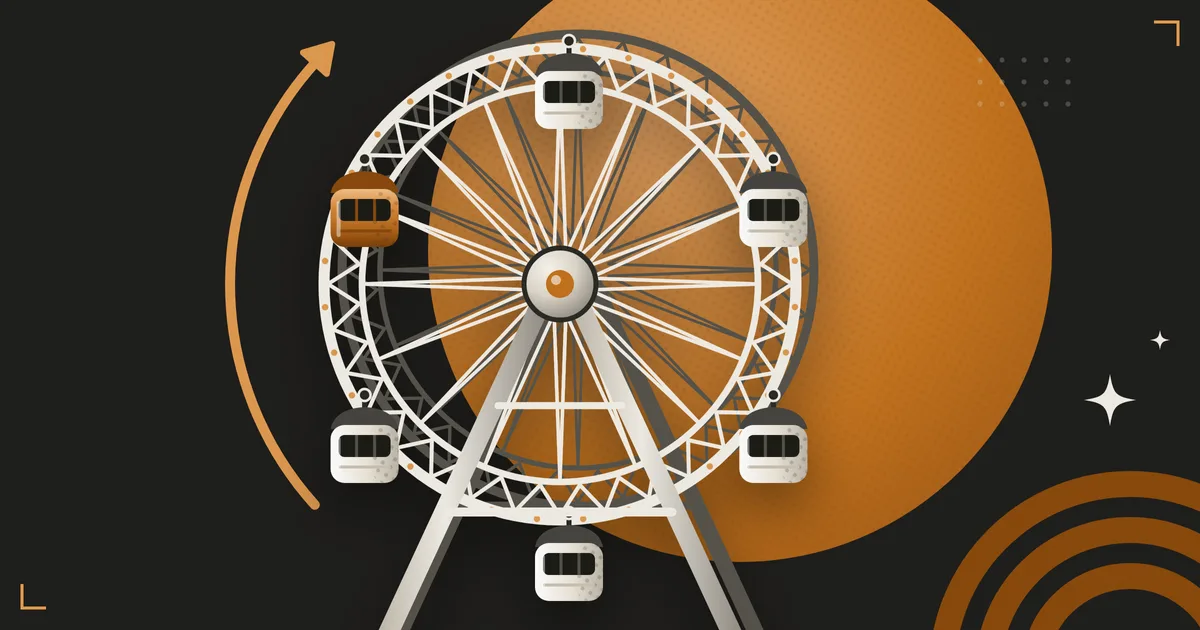
In September 2025, when presenting its agent development kit, Anthropic summed up an agent’s loop in four steps: gather context, take action, verify work, repeat. Take a simple request, received by email: a customer wants to change the delivery address on their order.
An agent’s loop, on a change of delivery address
- Gather context
Read the email, find the order, check whether it has already shipped.
- Act
Change the address, or prepare the change if the action needs approval.
- Verify
Read the order again to confirm that the address has really changed.
- Repeat
If it fails, try another route, ask a question or stop.
The agent does not guess: it goes and fetches what it needs in the management software, with the tools it has been given. And if the order is locked or the address incomplete, the verification fails and it starts again with that information.
The third step is the most important: reading again, instead of assuming the call succeeded. In its 2024 text, Anthropic insists that an agent must gain “ground truth” from its environment at each step, such as the result of a tool call or the execution of code, to assess its progress. An agentic loop that verifies nothing chains one assumption after another, and an error from the first turn is carried into every later one.
How does an agent verify its own work?
There are several ways to close the loop, and they are not equal. The September 2025 article distinguishes three:
- Written rules. “The best form of feedback is providing clearly defined rules for an output, then explaining which rules failed and why.” An expected format, a required field, a test that passes or fails: the answer is clear, and the agent knows what to correct.
- Visual feedback. For an interface or a formatted document, a screenshot makes it possible to check what a human would see.
- A second model acting as judge. One model can assess another’s work against fuzzier criteria, such as the tone of a text. This is generally less robust, Anthropic notes, and it adds response time.
The 2024 text describes the same idea under the name evaluator-optimizer: one model call produces a response, another evaluates it and sends back its comments, in a loop. This pattern is most effective, it adds, when the evaluation criteria are clear and each round of correction brings a measurable gain. In other words, if you cannot write down what a good result is, the loop will not know it any better than you do.
When should the loop stop?
A loop with no end is not a harder-working agent: it is a growing bill and errors that pile up. Anthropic notes that it is common to add stopping conditions, such as a maximum number of iterations, to keep control. Four brakes work together:
- a number of turns beyond which the agent hands control back;
- a budget per task, in model calls or in euros;
- a success criterion written in advance, which the verification can recognise;
- stopping when blocked: when the agent can no longer progress, it stops and says why, instead of improvising.
The principle holds outside AI too: a loop with no brake multiplies the error instead of correcting it.
From the field
A client learned it the hard way: on Palmora Property, a bulk repair through the API, launched with no rate limit, produced 754 failures; relaunched with a limited rate and automatic retries, it fixed all 837 targeted records. It was not an agent, but the lesson applies as it stands.
What safeguards should surround an agent’s loop?
An agent acts with the tools it is entrusted with. The risk therefore lies not only in what it writes but in what it can do. OWASP, a non-profit foundation dedicated to software security, places this risk in its 2025 ranking of the top ten risks for large language model applications, under the name Excessive Agency.
Definition
Excessive Agency
Excessive autonomy that allows damaging actions in response to an unexpected, ambiguous or manipulated output from the model, whatever the cause of the malfunction. OWASP names three causes: too many functions, too many permissions, too much autonomy.
The countermeasures OWASP recommends read like a design checklist:
- give the agent only the extensions strictly necessary for its task;
- reduce to a minimum the permissions these extensions have on other systems;
- have a human approve high-impact actions before they are carried out;
- check authorisations in the target systems, rather than letting the model decide whether an action is allowed;
- limit the rate of actions, so that a runaway loop stays small.
In the order example, that means an agent that can read orders and change an address, but neither refund nor delete; and management software that itself refuses any change to a shipped order, whatever the agent thinks.
The same logic applies to its access keys: an agent does not need to read the ones it uses. A relay can add them at the moment of the call, only towards the intended service, and the model never sees them go by. We explain this principle in our article on the secrets vault.
Where does the human fit in the loop?
“Human in the loop” does not mean a human watching every turn. Anthropic describes agents that pause to get human feedback at checkpoints, or when they run into a blocker. OWASP, for its part, asks for human approval before high-impact actions.
The right question is therefore: which action is irreversible, or commits the company? That is where the human belongs. An agent that asks for approval at every turn is no longer really an agent; one that never asks will eventually publish, pay or delete what it should not have. This division of roles is developed in our article on the role of the human alongside AI.
Two loops that we run
A content loop, every morning
Since early October 2026, a loop has prepared drafts for this blog every morning. It starts from a set of written instructions, always the same, and follows a fixed order:
The content loop, every morning, in this order
- Repair before producing
Three articles at most.
- Search
The topics missing in each section.
- Write
Two drafts at most.
- Link
Put in the links between articles.
- Improve
One offer page, without touching its prices.
Its checks are rules, not opinions: a script checks each draft (vocabulary, punctuation, links, structure), then the whole site has to build without errors. It hands over its drafts for review, with a three-part report: what is done, what remains to be decided, the next iteration.
Its brakes are written into the instructions: it never publishes, never adds anything to the site itself, and when it gets stuck, it stops and says so. The only action that puts an article online is human: read it, then approve. These are design choices; we do not yet have enough hindsight to put a figure on the gain.
An SEO engine with four agents
This site’s SEO relies on a different set-up. Every day, a scan that uses no AI reads Google Search Console and builds the work queue. Every week, four agents (keywords, content, refresh, audit) draw on it; the audit does its technical checks on a sample and runs before the writing, and the run delivers two pieces of content at most, as drafts. Its first unattended run, on 30 August 2026, produced nothing: the agent orchestrating it asked a question instead of deciding, and with nobody to answer, a question asked ends the run. Its instructions have forbidden any question along the way ever since. The detail of this set-up is in our guide to the AI agent in production, from demo to product.
What one turn of the loop costs
Every turn is a call to the model, and what it reads grows as the loop advances: the gathered context, the tool results, the checks. Since each turn generally re-reads what came before, the cost of a loop rises faster than its number of turns. The calculation is detailed in our guide to the cost of AI in business.
That is why a well-designed loop does not hand every turn to the same model. Checking a format needs no AI at all, sorting a request is done with a small model, and the large model steps in only where it adds something. We apply this routing everywhere: on Palmora Property, moving translation to a suitable AI model cut its cost by a factor of 60, and 95% of segments are served from a cache, with no call to the model. This is the principle behind our AI at the right cost offer: each task given to the model that is just sufficient, with a budget and caps per use.
Where to start
Before building a loop, look at the task as it is done today: what comes in, what must come out, who checks it and what would be serious in case of error. If you cannot yet write down what a good result is, start there, because it is the condition for verification to work. It is also what we do before recommending anything: look at your workflows, your tools and how they integrate with one another, the team’s obstacles and its training needs. Our digital and AI maturity audit is made for this, with a written GO or NO-GO for each project.
Frequently asked questions
What is the difference between agentic AI and generative AI?
Generative AI produces content in response to a request: a text, an image, a summary. Agentic AI places a generative model in a loop, with tools: it acts in software, looks at the result of its action and decides on the next one, until it reaches the goal or a limit. The model can be the same; what changes is that it is allowed to chain actions together.
What does “human in the loop” mean?
The phrase means a human placed at specific points in an agent’s loop, where a decision commits something: publishing, paying, deleting, writing to a customer. OWASP recommends human approval before any high-impact action. The human does not have to watch every turn: they approve what cannot be undone, and they are alerted when the agent gets stuck.
How many turns should an agent take before it stops?
There is no universal number: it depends on the task and on what a turn costs. Set a maximum at design time, with a budget per task and a success criterion written in advance. If the agent hits the limit without succeeding, it should hand control back with what it has tried, rather than keep spending.
Can an agent loop run unattended?
Yes, provided it cannot commit anything on its own. Our content loop runs every morning with nobody watching it, but it publishes nothing: it hands over drafts that a human reviews before anything goes online. What stays under human control is the irreversible actions and those that commit the company, and the blockers, which the loop flags instead of improvising.
Sources
- Building effective agents (new tab)anthropic.com
- Gather context, take action, verify work, repeat (new tab)claude.com
- Excessive Agency (new tab)genai.owasp.org
Jim · founder of Brain Plus AI
Also in business ai

Understand9 min
What an AI agent is, and what it is not
An AI agent chooses its own steps and tools to reach a goal. That is useful on open-ended tasks, but it is neither a relabelled chatbot nor the default answer to every automation.
Practical guide10 min
An AI agent in production: from demo to product
An AI agent demo impresses quickly. Turning it into a tool a team uses every day takes an owner and written rules: what four public cases show, and what we run ourselves.

Practical guide10 min
The cost of AI in business: tokens, routing and forecasting
What you really pay when you use an AI through an API: input and output tokens, the context sent back with every call, an agent's turns. And a method to forecast the bill before you receive it.