
Contents11
- 01What does the ChatGPT Pro 500 plan include?
- 02Has the $200 plan really been cut in half?
- 03Why is OpenAI charging for speed and quantity?
- 04How can OpenAI cut and raise its prices on the same day?
- 05And what about Europe?
- 06Will OpenAI go public?
- 07How could the competitors respond?
- 08The questions we are asking
- 09Should you pay $500 a month for ChatGPT?
- 10What these forty days teach us
- 11Frequently asked questions
Five hundred dollars a month. That is the price of ChatGPT Pro 500, the new plan announced by OpenAI on 29 September 2026 at its DevDay conference in San Francisco. The same day, the $200 plan, which had until then been the most expensive, kept its price but lost half of what it contained. And while subscribers were doing their sums, the question of OpenAI’s IPO, in preparation since June, hung on a sentence from Sam Altman: “not 2026”.
This piece, from our Business AI section, takes a step back from these forty days. What OpenAI actually announced, why a vendor that promises to bring down the price of AI is selling its most expensive plan at the same time, and what its competitors can answer. After all, the market moves fast, and everyone is watching to see who will move next.
In short
ChatGPT Pro 500 costs $500 a month. It gives 25 times the usage of the $20 Plus plan and is the only personal plan that opens up Ultrafast mode, up to 8 times faster in Codex.
The price of the $200 Pro plan has not fallen. Its content has: 10 times the usage of Plus instead of 20 times, and 100 GPT-6 Pro messages a week instead of 200.
The result: all Pro plans now cost the same per “Plus dose”. The volume discount has gone.
At the same time, OpenAI cuts the price of its new model GPT-6.1 Sol to a fifth of GPT-6 Astra’s. Intelligence gets cheaper; speed and quantity are what you pay for.
In June, OpenAI filed a confidential IPO application. On 12 September, Sam Altman announced there would be no listing in 2026, citing safety.
Anthropic, Google, xAI, Meta and Mistral had not matched the $500 price as of 9 October 2026. Their possible responses range from raising prices to going free.
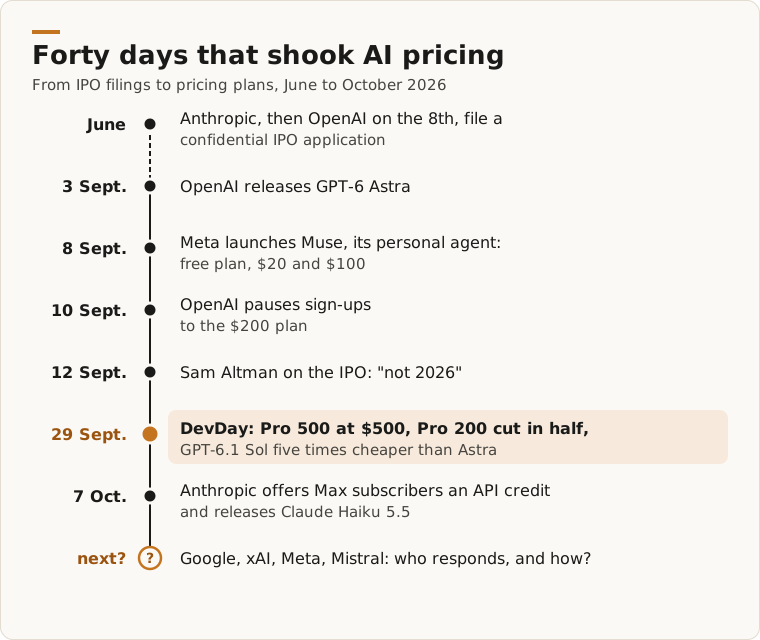
Forty days, from the release of GPT-6 Astra to Anthropic’s first response. The sources for each date are in the article.
What does the ChatGPT Pro 500 plan include?
On paper, the promise comes down to two words: more and faster. According to Engadget, Pro 500 offers OpenAI’s biggest usage allowance and access to Ultrafast, which the company presents as its “premium speed tier for workloads where speed matters most”. Simon Willison’s live blog of the conference gives the multiplier: 25 times the usage of Plus.
Ultrafast is not a new model. It is a fast lane for an existing model, GPT-6 Astra: up to 300 tokens per second, which is up to 8 times faster in Codex, OpenAI’s coding tool. In the API, the same speed costs 6 times the normal price, according to VentureBeat. Sam Altman summed it up on stage in his own way: “it’s worth it”.
To put the price in context, here is the staircase of ChatGPT’s personal plans in October 2026.
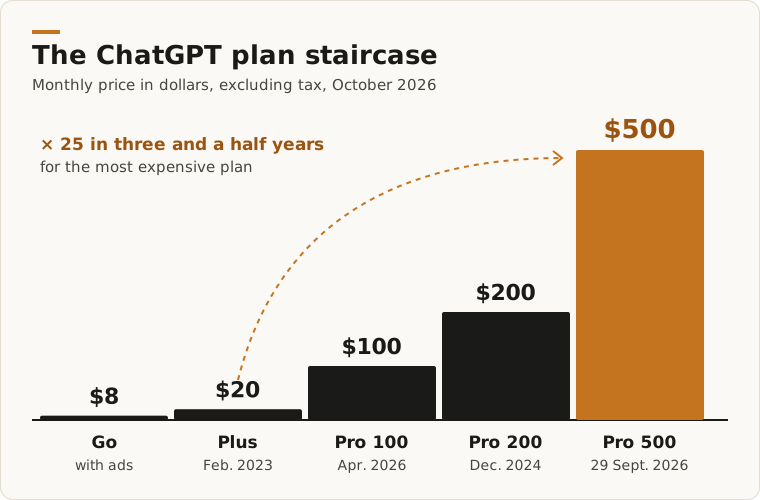
Monthly prices in dollars, excluding tax. Plus came out in February 2023, Pro at $200 in December 2024, Pro at $100 in April 2026, Pro 500 on 29 September 2026.
In three and a half years, ChatGPT’s most expensive plan has gone from $20 to $500. Twenty-five times the price, for a product that still has the same name.
Has the $200 plan really been cut in half?
Its price, no. Its content, yes. That is the nuance that made people grumble.
The story starts on 10 September 2026. A week after the release of GPT-6 Astra, OpenAI suspended new sign-ups to the $200 plan, Business Insider reports. Too much demand for the available computing power. The plan reopened on the day of DevDay, with a revised allowance:
| $200 Pro plan | Before 29 September 2026 | After |
|---|---|---|
| Usage in Codex and Work | 20 times Plus | 10 times Plus |
| GPT-6 Pro messages in ChatGPT | 200 a week | 100 a week |
| Limit per five-hour window | yes | removed |
| Price | $200 | $200 |
Sources: Engadget and Business Insider for the limits, Fortune for the five-hour limit.
Thibault Sottiaux, who leads engineering for Codex, did the sum himself on X: in API spend equivalent, the new plan works out at half of the old one, according to Business Insider. Existing subscribers keep their limits during a transition period, then receive a one-off credit to help them through the change.
Let us get the calculator out. If you divide the price of each plan by the usage it includes, expressed in multiples of Plus, you get the price of a “Plus dose”.
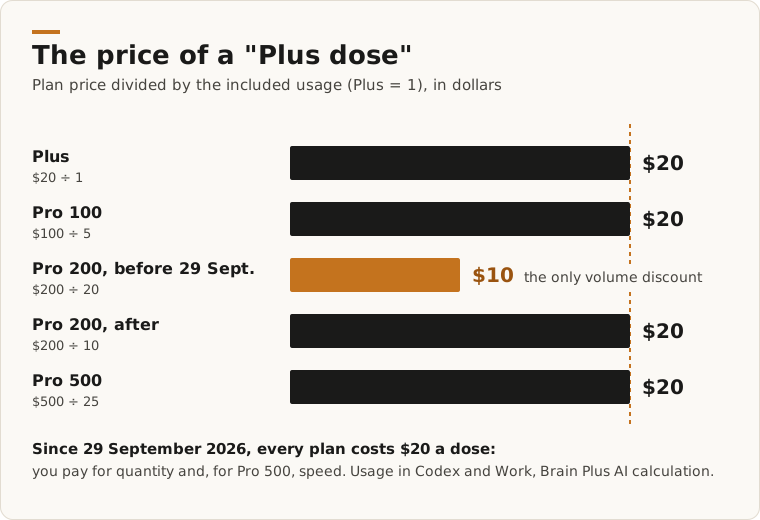
Monthly price divided by the usage included in Codex and Work, in multiples of Plus (Plus = 1, Pro 100 = 5, Pro 200 = 20 then 10, Pro 500 = 25). Brain Plus AI calculation based on the figures published on 29 September 2026.
The result is crystal clear. Before DevDay, the $200 plan was the only one to offer a volume discount: the dose at $10 instead of $20. Today, Plus, Pro 100, Pro 200 and Pro 500 all cost $20 a dose. What changes from one plan to the next is the quantity and, for Pro 500, the speed. Nobody pays less any more for using a lot.
Why is OpenAI charging for speed and quantity?
A short look back helps explain the decision. A month after the launch of the $200 plan, Sam Altman wrote this on X, as Fortune had pointed out:
insane thing: we are currently losing money on openai pro subscriptions! people use it much more than we expected.
He added that he had chosen the price himself, thinking it would make money.
A fixed-price subscription and consumption that varies from one user to the next rarely go well together. The all-you-can-eat restaurant knows this well: everything is fine until the day a rugby team sits down. But the heaviest consumers of AI are no longer humans asking questions; they are agents at work. On a DevDay slide, OpenAI announced that its agents succeeded without intervention on 35% of tasks of 8 to 16 hours in July 2026, against 10% in January, according to Simon Willison’s live blog. An agent that works for eight hours does not consume like a human who chats for twenty minutes.
Hence our reading, which remains an interpretation: the unlimited or near-unlimited plan no longer makes economic sense when the machine works on its own. So OpenAI is doing what theme parks do: the entry ticket gives access to the same rides, but the fast-track pass is paid for separately. Here, the fast-track pass is called Ultrafast.
How can OpenAI cut and raise its prices on the same day?
That is the paradox of DevDay. While launching its most expensive plan, OpenAI presented GPT-6.1 Sol, a model that comes close to GPT-6 Astra in coding and computer use for a fifth of its price: $2 per million input tokens and $10 per million output tokens, against $10 and $50 for Astra, according to VentureBeat. Sam Altman repeated the goal on stage: “to give you the best combination of intelligence and capability at every price point in the whole market”, according to TheStreet.
The two moves do not contradict each other. The price of an intelligent answer is falling, which has been the underlying trend since 2023, at every vendor. But the volume of answers is exploding, because agents ask for thousands of them. The unit price falls, the total bill rises. Anyone who has ever received an API bill knows the feeling.
What DevDay also showed is the size of the playing field: more than 1.2 billion people use ChatGPT every week and 2.5 million businesses use it, according to Fortune. With a base like that, it only takes a small fraction of users moving up a tier to change the revenue figure. For a company, it is also an audience: getting cited by ChatGPT and AI search engines now matters as much as ranking well on Google.
And what about Europe?
A bit of a letdown for European readers. Dots, the personal agents presented as the star of DevDay and offered to Pro subscribers, are not available in the European Economic Area, Switzerland or the United Kingdom, Fortune reports, putting it down to privacy rules. A European subscriber who pays the same price as an American is therefore not quite buying the same plan. That is not a detail when comparing $200 and $500 a month.
Will OpenAI go public?
Yes, one day. Not in 2026.
On 8 June 2026, OpenAI confirmed that it had filed with the SEC, the US stock market watchdog, a confidential draft of its IPO prospectus, Quartz reports. The filing, the company said at the time, “gives us the option to go public sooner if that ends up being best”. Anthropic had filed its own a week earlier. The amounts at stake:
raised by OpenAI in March
OpenAI’s valuation in that round
Anthropic’s valuation at the time of its own filing
Then the tone changed. On 12 September, in an interview with Fortune, Sam Altman said that, “given everything happening with safety”, it would be an “ill-advised moment to go public”. Asked about 2026, he answered: “I would say not 2026.” Fortune ties this postponement to concerns about AI agents that have hacked websites; the best-known case remains that of OpenAI’s agents that attacked Hugging Face in July. The same day, Dario Amodei, the head of Anthropic, called on labs to slow the progress of their most powerful models. On 29 September, at DevDay, the line did not change: safety first, no timetable.
And the money? On 29 September, an anonymous source cited by Reuters put OpenAI’s annual revenue run rate near $70 billion, with enterprise sales more than doubled since July. On 9 October, Bloomberg instead headlines $70 billion expected by the end of the year. OpenAI has confirmed neither. Even the numbers move fast.
The link with the plans? We do not know it from the inside, and OpenAI has never made the connection. But a company preparing for an IPO has to show rising revenue and margins that hold. Charging the biggest consumers for speed and ceasing to offer them a volume discount goes in that direction.
How could the competitors respond?
It is the question the whole market is asking. As of 9 October 2026, no competitor has followed OpenAI to $500. Here is where the top end stands.
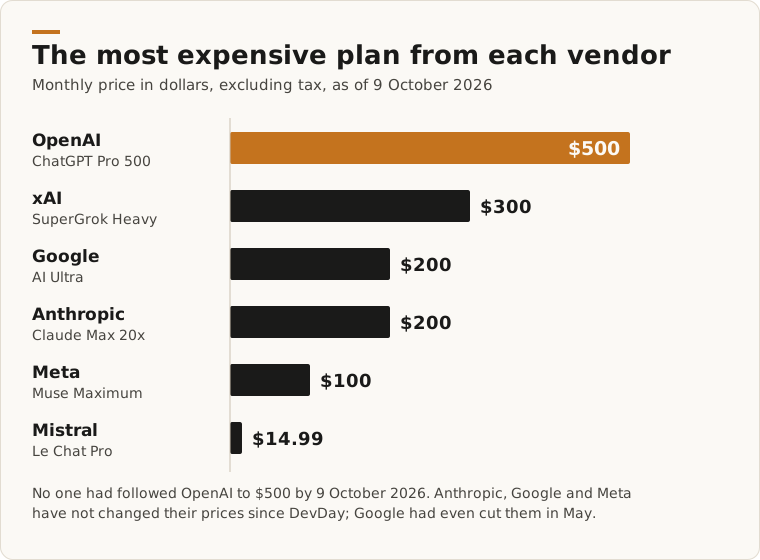
Monthly prices in dollars, excluding tax, taken on 9 October 2026: Anthropic, Google, Mistral; xAI from its July 2025 launch, Meta from TechCrunch.
Each already has a different strategy, and therefore a different likely response.
Anthropic keeps Claude Max at $100 and $200 a month, for 5 and 20 times the usage of its Pro plan, according to its help page. On 7 October, the vendor chose a different weapon: a monthly API credit for its Max subscribers, $100 for Max 5x and $200 for Max 20x, and a new small model, Claude Haiku 5.5, at $0.10 per million input tokens for requests of under 100,000 tokens, Simon Willison notes. Rather than raising the price, it loads more into the plan. It remains to be seen whether this will hold when its own agents consume as much as OpenAI’s, and while it, too, is preparing a listing.
Google had taken the opposite road as early as 19 May: a new AI Ultra at $100 and its most complete plan brought down from $250 to $200, as its blog announced. With its own chips and data centres, Google can afford to play the price-cutting game for longer than the others.
xAI was the first to cross the $300 mark with SuperGrok Heavy, in July 2025. It is no longer the most expensive. It is hard to imagine Elon Musk leaving that title to Sam Altman without reacting, but nothing has been announced.
Meta is attacking from below. Its personal agent Muse, launched on 8 September in the United States, has a free plan, then two plans at $20 and $100, according to TechCrunch. Meta plans to earn its living from transaction commissions rather than from subscriptions: a model that makes OpenAI’s $500 very hard to explain to the general public.
Mistral, in France, sells Le Chat Pro at $14.99 a month, according to its pricing page. No race to the top end: its trump card remains that of the European vendor, for companies that want to depend a little less on the American cloud.
Then there are the Chinese vendors, DeepSeek, Alibaba with Qwen, Zhipu or Moonshot, which publish open-weight models that you can run yourself. They do not sell a $500 plan; they pull unit prices down for everyone.
The questions we are asking
We do not know what comes next, but we know which questions to watch in the coming weeks.
- Will Anthropic follow? A more expensive Claude Max, or a plan that stays at $200 while promising more? Its IPO, in preparation since June, will weigh on the decision.
- Will Pro 200 subscribers leave? The end of the transition period will tell whether they move up to $500, drop down to $100 or go elsewhere.
- Will speed become the new dividing line? If Ultrafast sells well, expect to see “fast lanes” from every vendor.
- Who will keep free plans going the longest? Meta and Google can afford to subsidise. OpenAI, which is preparing its listing, a little less so.
- Will agents end up being paid for the work they deliver? A monthly plan suits a human. An agent that works eight hours a day looks more like a line on an API bill than a subscription.
Should you pay $500 a month for ChatGPT?
For an individual, the answer comes down to three questions.
- Does an agent work for you several hours a day? If you chat with ChatGPT, even a lot, Plus or Pro 100 is more than enough.
- Does waiting time cost you money? Ultrafast makes sense when every minute of a developer’s or analyst’s time is spent waiting for the machine. Otherwise, you are paying for a fast-track pass for an empty queue.
- Have you compared it with pay-as-you-go? With a model like GPT-6.1 Sol at $2 per million input tokens, many uses cost less through the API than through a plan.
For a company, the question changes in nature. A personal subscription helps one person; it connects nothing to your data, automates no process and logs nothing. Multiplying $200 or $500 plans per employee quickly ends up costing more than an architecture that gives each task to the right model. Before equipping a team, our guide to integrating AI in business sets out the questions to settle: the task, the data, the model, the cost and the rules.
From the field
We saw this on the translation pipeline we operate for Palmora Property, a property portal in six languages: switching provider cut the cost 60-fold.
On an AI bill, the choice of model for each task weighs far more than the choice of plan.
What these forty days teach us
Consumer AI is leaving its pricing infancy behind. For three years, people paid for a subscription the way they pay for Netflix: one price, one access, few questions. With agents, the model moves closer to electricity: what matters is how much you consume and how fast. OpenAI is the first to embrace it openly, with a $500 plan and a $200 plan that gives less for the same price.
The coming weeks will show whether the others follow, resist or work around it. One thing is certain: an AI price noted today will be wrong in three months. If you want to know what your AI subscriptions and uses really cost you, and what they could cost with the right model for each task, that is what our AI at the right cost offer is for.
Frequently asked questions
How much does ChatGPT Pro cost in October 2026?
ChatGPT Pro comes in three versions: Pro 100 at $100 a month, Pro 200 at $200 and Pro 500 at $500, excluding tax. They give 5, 10 and 25 times the usage of the $20 Plus plan in Codex and Work respectively. Only Pro 500 opens up Ultrafast mode. These prices are the ones announced at DevDay on 29 September 2026; check OpenAI’s pricing page before subscribing.
Has the $200 ChatGPT plan come down in price?
No. The price stays at $200 a month, but the included usage was cut in half on 29 September 2026: 10 times Plus instead of 20 times in Codex and Work, and 100 GPT-6 Pro messages a week instead of 200. In return, the limit per five-hour window disappears. Existing subscribers keep their limits during a transition period, then receive a one-off credit.
When will OpenAI go public?
Not before 2027. OpenAI filed a confidential draft prospectus with the SEC in June 2026, but Sam Altman said on 12 September that a listing would be ill-advised in 2026, given the safety stakes of AI. No date, no stock exchange and no price per share had been announced as of 9 October 2026.
What is ChatGPT’s Ultrafast mode?
Ultrafast is a fast lane for the GPT-6 Astra model, not a new model. OpenAI claims up to 300 tokens per second, which is up to 8 times faster in Codex. On the subscription side, it is reserved for Pro 500 and Enterprise customers. In the API, it costs 6 times the normal price. A version for GPT-6.1 Sol has been announced without a date.
What is the most expensive AI subscription in 2026?
As of 9 October 2026, it is OpenAI’s ChatGPT Pro 500, at $500 a month. Next come xAI’s SuperGrok Heavy, launched at $300 in July 2025, then Google AI Ultra and Anthropic’s Claude Max 20x, at $200 each. Meta Muse stops at $100 and Mistral’s Le Chat Pro costs $14.99. Prices change often: check them with the vendor.
Sources
- Engadget (new tab)engadget.com
- Simon Willison’s live blog (new tab)simonwillison.net
- 6 times the normal price (new tab)venturebeat.com
- February 2023 (new tab)techcrunch.com
- April 2026 (new tab)techcrunch.com
- Business Insider (new tab)tech.yahoo.com
- Fortune (new tab)fortune.com
- Fortune (new tab)fortune.com
- TheStreet (new tab)finance.yahoo.com
- Quartz (new tab)finance.yahoo.com
- Fortune (new tab)fortune.com
- Safety first, no timetable (new tab)cnbc.com
- Reuters (new tab)srnnews.com
- Bloomberg (new tab)bloomberg.com
- Anthropic (new tab)support.claude.com
- Google (new tab)blog.google
- Mistral (new tab)mistral.ai
- July 2025 launch (new tab)techcrunch.com
- TechCrunch (new tab)techcrunch.com
- Simon Willison (new tab)simonwillison.net
Jim · founder of Brain Plus AI
Also in business ai

Practical guide7 min
How to get cited by ChatGPT and AI search engines
What actually gets a site cited by ChatGPT, Claude or Perplexity: let the bots read it, answer straight away, source every fact, mark up only what is shown. And how to measure it without fooling yourself.

Practical guide10 min
The cost of AI in business: tokens, routing and forecasting
What you really pay when you use an AI through an API: input and output tokens, the context sent back with every call, an agent's turns. And a method to forecast the bill before you receive it.

Practical guide11 min The topic guide
Integrating AI in business: private and at the right cost
For teams of 20 to 500 people, integrating AI comes down to answering five questions in order: which task, where the data goes, which model, at what price, under what rules. This guide takes them one by one and points to our detailed articles.