
Contents6
In an accounting firm, half of all client conversations come down to the same request: “could you send us your receipts?”. They arrive in a jumble, by email, as blurry photos, or in an envelope at the end of the quarter. And when a manager wants to know where their expenses go, someone at the firm opens the software, filters, exports, and answers two days later.
Bots change both moments, but not with the same tool. Some bots execute; others you ask questions.
In short
An execution bot receives the client’s receipt on a messaging app and records it in the accounting software on its own.
An analysis bot answers accountants’ and managers’ questions about the data in a client file.
Both can stay inside the firm: on its own servers, or in a closed environment nothing leaves.
The bot that executes: the client sends, the file fills up
The client takes a photo of the receipt and sends it on Telegram or WhatsApp, like any message. The bot reads the amount, VAT, date and supplier, picks the category, then creates the expense in the firm’s software with the photo attached. If the supplier already exists, it reuses it; otherwise it creates it. The client gets a confirmation within seconds.
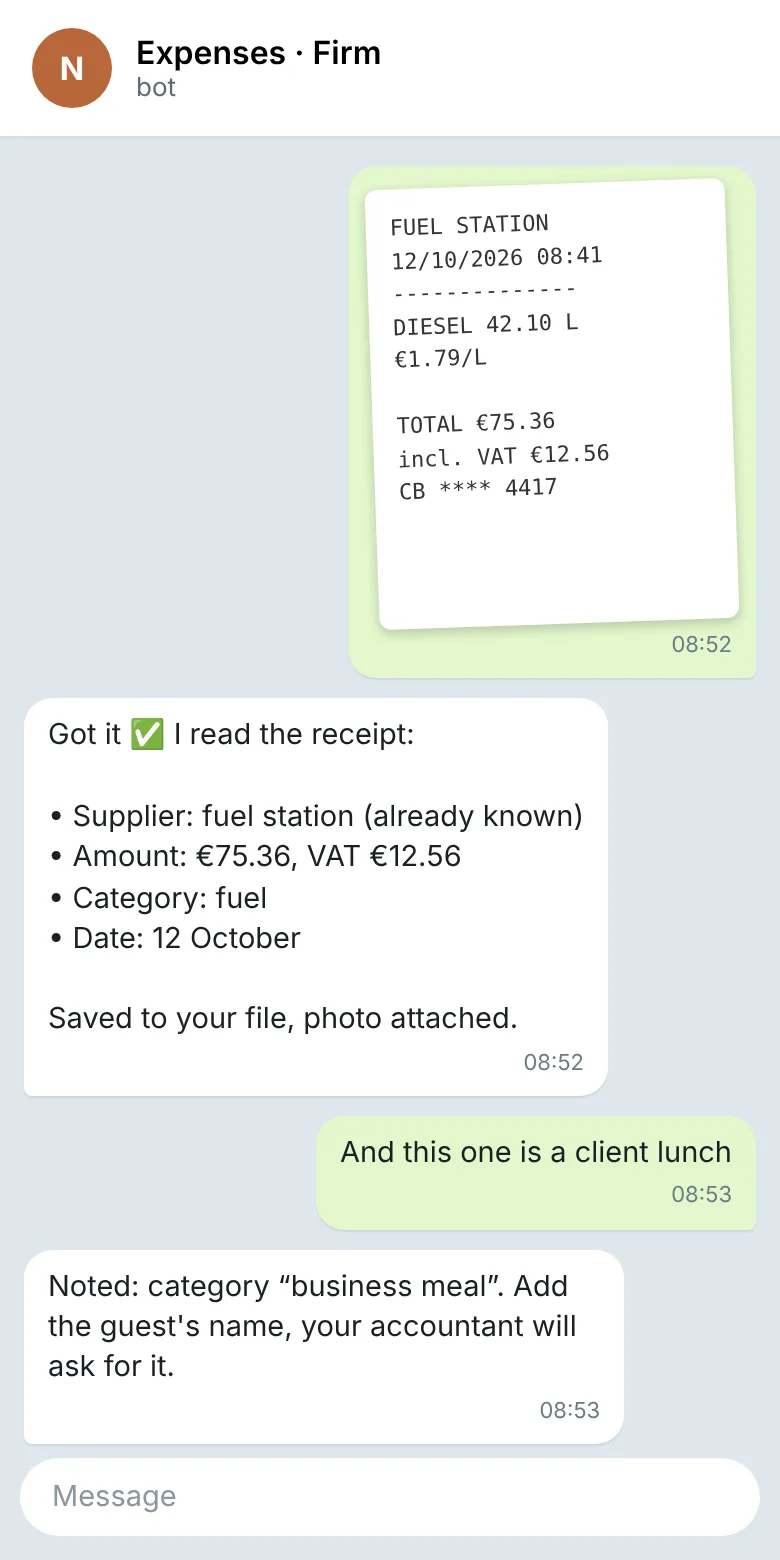
Mockup: a client sends a fuel receipt, the bot records it in their file with the photo.
This bot does not need to be a conversational AI. Once the receipt is read, it is a fixed sequence: read, check, write to the software, confirm. That is what makes it reliable and cheap. It can even write to two systems at once during a software migration without the client noticing: if the second one fails, the first stays up to date and the confirmation still goes out.
How a receipt travels
- The client
Sends a photo of the receipt on their messaging app.
- Reading
Amount, VAT, date, supplier and category are extracted.
- Writing
The expense is created in the firm’s software, photo attached.
- Confirmation
The client gets a summary, the accountant an up-to-date file.
For the firm, the gain is simple: documents arrive as they happen, already sorted, instead of in one batch at closing.
Structured at the door: what makes everything else fast and cheap
The real job of the execution bot is not filing a photo. It turns a receipt into clean data: a recognised supplier, net amount and VAT kept apart, a date, a category from the chart of accounts, a client, and the photo attached to all of it. That work happens once, when the document arrives, while the client is still there to answer if something is missing.
Everything that comes after benefits:
- Questions cost almost nothing. “How much on fuel this month?” becomes a simple sum over rows already sorted. The AI does not reread a hundred photos to answer: it reads a few figures, which takes far less computing, so it costs far less.
- Answers are right. A figure computed from structured data is the same every time. An AI that had to guess a total from loose documents can get it wrong, and nobody would notice.
- A small model is enough. When data arrives clean, the model only has to understand the question. That is what lets everything run on a modest server, inside the firm.
- Anomalies stand out. A receipt with no vehicle, an unknown supplier, VAT that does not match the rate: the bot flags it on arrival, not three months later at closing.
- The file stays readable by every tool. Well-sorted data can be read by the accounting software, a spreadsheet, a dashboard or another bot, with no rework. Changing software no longer means re-entering everything.
- Duplicates do not get through. The same receipt sent twice has the same supplier, date and amount: it is caught at once.
A document structured at the door is one less question to ask the client, and a cheaper question to ask the AI.
The bot you question: the file answers in plain language
The second kind serves the firm itself. An accountant, a chartered accountant or a manager asks the question as they would ask a colleague: “how much did this client spend on fuel this month, compared with last year?”. The bot fetches the entries, does the maths, and flags what looks unusual.
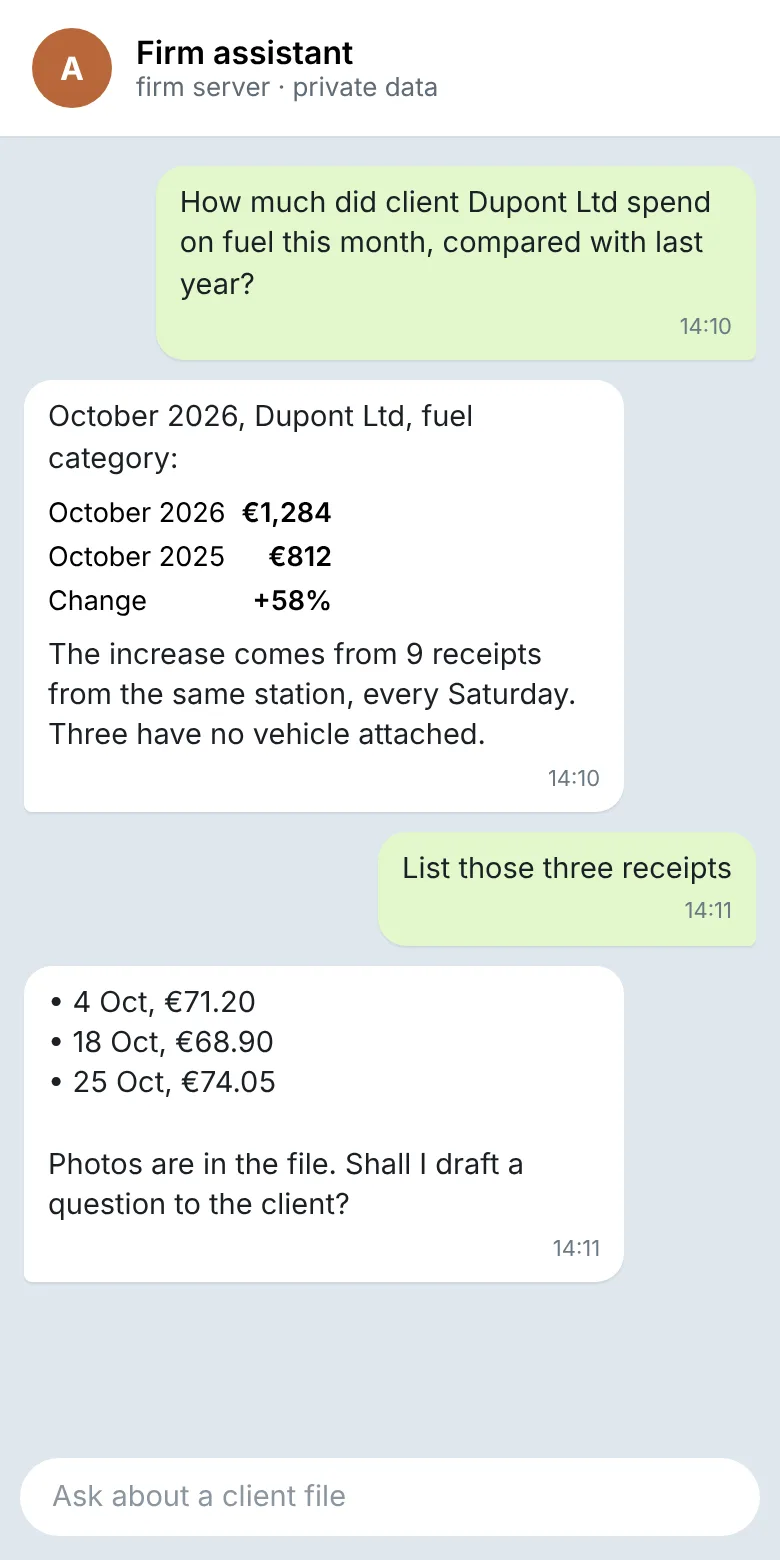
Mockup: an accountant queries a client file, the bot computes the change and points to the receipts to check. The data is fictitious.
Here you need an AI that understands the question. It connects to the accounting software through a connector (an MCP server, for instance) that lets it read, and only read, the data in the file. It does not replace the accountant’s judgement: it saves the half hour of exports and spreadsheets before judgement can start.
The execution bot
For the firm’s clients
A fixed path, always the same
It writes to the software
AI only to read the receipt
The analysis bot
For accountants and managers
Open questions
It reads, it does not write
An AI that understands the question and the data
Confidentiality: a closed environment
An accounting file holds everything sensitive about a business: salaries, margins, suppliers, bank accounts. The firm’s professional secrecy does not stop at the door of an online AI service. That is why these bots are set up in a closed environment, depending on how strict the firm needs to be (the options are detailed in the four levels of private AI):
- on its own servers, in its offices or data centre;
- on a dedicated server in Switzerland or the European Union, rented in the firm’s name and used by no one else;
- in a private cloud where the AI model runs without the data leaving, or being used to train anything.
In all three cases, receipts, entries and the questions asked stay within a perimeter the firm controls. Access is set per person: a client sees only their file, an accountant only their mandates.
Key takeaway
The execution bot does not need a large AI model: only reading the receipt calls for one, and a small model hosted by the firm is enough.
What about performance, without the big online services?
This is the objection we hear most: an AI hosted in-house would be worse. That was true two years ago. For this kind of work it no longer is, for four reasons.
- Recent open models have caught up. To read a receipt, understand a question about figures or summarise a file, models you can install yourself now do the work only the big services could do before.
- Computing power can be rented. A server with a dedicated graphics card rents by the month, in Switzerland or Europe. It serves only the firm, so it never waits in line.
- The bot does not guess, it reads. Figures do not come from the model’s memory but from the accounting software, at the moment of the question (that is the idea behind RAG, explained in enterprise RAG: an AI that answers from your documents). The result depends on data quality far more than on model size.
- Each task gets its own model. A small fast model reads receipts, a stronger one answers analysis questions. This routing keeps answers fast and the bill low, without sending anything outside.
What remains to check before launching is compatibility with the firm’s software: not every package opens its data in the same way. It is the first thing we look at, as in any project described in integrating AI in your business.
Where to start
The execution bot is the easiest to launch: it plugs into the existing software, changes nothing in clients’ habits, and its effect shows from the first month in documents received on time. The analysis bot comes next, on the same data, once it arrives clean and on time.
To price both, start from our AI at the right cost offer, or write to us with the name of your accounting software.
Jim · founder of Brain Plus AI
Also in business ai

Practical guide2 min
AI in accounting and finance: less data entry, more analysis
What AI changes for an accounting or finance team: reconciliations, closing comments, summaries, supplier queries. What stays expert work.

Choose and price9 min
Private AI in business: the four levels of control
A "private" AI is not a product, it is a degree of control over your data. We distinguish four levels, from an API used as is to a model installed on your premises, and a simple way to choose task by task.

Understand9 min
Enterprise RAG: an AI that answers from your documents
RAG connects an AI model to a company's documents so that it answers by citing its sources. How it works, when it is useful, why it sometimes misses the point, and what to set up before opening it to the team.