
Contents9
- 01The deadlines, from 2026 to 2028
- 02AI Act: four dates after the July revision
- 03Cybersecurity: the CRA has started, NIS2 is waiting
- 04Products: software and machinery
- 05Data and cloud: the Data Act in three steps
- 06French e-invoicing: September 2026, then September 2027
- 07Outside Europe: two US states to watch
- 08What concerns you, depending on what you do
- 09Frequently asked questions
Between autumn 2026 and summer 2028, a business that uses AI, buys cloud services or publishes software faces around ten European deadlines, plus a few US state laws if it sells across the Atlantic. Each text has its own timetable, and several were revised in 2026. This page brings them together in one place, date by date.
It is a page kept up to date in our Business AI section: version of 19 October 2026, with each date checked that day against its official source. It is not legal advice: to know whether a text applies to you, your DPO, your accountant or a lawyer has the final say.
In short
The next AI Act deadline falls on 2 December 2026: marking of content by generative tools already on the market, and two new prohibitions.
The high-risk rules are postponed to 2 December 2027 (recruitment, staff management, credit) and 2 August 2028 (AI built into regulated products).
From 12 January 2027, cloud providers can no longer charge switching fees, under the Data Act.
Since 11 September 2026, a maker of software or connected devices must report an actively exploited vulnerability within 24 hours; its security requirements follow on 11 December 2027.
NIS2 still has no application date in France, and French SMEs must start issuing e-invoices by 1 September 2027 at the latest.
The deadlines, from 2026 to 2028
- 1 September 2026
Every business in France must be able to receive e-invoices; large companies and mid-caps issue them.
- 11 September 2026
Cyber Resilience Act, duty to report actively exploited vulnerabilities and severe incidents.
- 12 September 2026
Data Act, connected products placed on the market from this date must make their data accessible by design.
- 2 December 2026
AI Act, end of the marking deadline for generative tools already on the market, and two new prohibitions.
- 9 December 2026
Transposition deadline for the new Product Liability Directive, which covers software.
- 1 January 2027
In Colorado, the automated decision-making law and the chatbot safety law take effect.
- 12 January 2027
Data Act, end of cloud switching charges.
- 20 January 2027
The EU Machinery Regulation applies, including to machinery whose safety functions rely on AI.
- 1 July 2027
In California, no more discipline or dismissal based solely on an automated system.
- 2 August 2027
AI Act, compliance for general-purpose models released before 2 August 2025; at least one regulatory sandbox per Member State.
- 1 September 2027
At the latest, French SMEs and micro-businesses issue e-invoices.
- 2 December 2027
AI Act, high-risk rules for Annex III uses.
- 11 December 2027
Cyber Resilience Act, essential cybersecurity requirements.
- 2 August 2028
AI Act, high-risk rules for AI built into Annex I products.
AI Act: four dates after the July revision
The EU regulation on AI was revised by Regulation (EU) 2026/1744, in force since 27 July 2026. The official timetable of the Commission’s service desk reflects it: prohibited practices and AI literacy have applied since February 2025, the general-purpose model rules since August 2025, and most of the text, including the Article 50 transparency rules, since 2 August 2026. Four deadlines remain:
- 2 December 2026: tools that generate images, video, audio or text and were on the market before 2 August 2026 must mark their content; two prohibitions are added, on intimate images generated without consent and on child sexual abuse material. The details are in our guide to marking generated content.
- 2 August 2027: general-purpose models released before 2 August 2025 must comply, and each Member State must have opened at least one regulatory sandbox.
- 2 December 2027: the high-risk rules apply to recruitment, staff management, credit scoring and the other Annex III uses.
- 2 August 2028: they apply to AI built into already regulated products (medical devices, toys, lifts).
What the revision moved, article by article, is explained in what the Digital Omnibus changed in the AI Act, and what these rules ask of a business that uses AI in our guide to the AI Act and the GDPR for SMEs.
Watch out
The high-risk postponement does not apply to the GDPR: its Article 22 already governs fully automated decisions. A CV screening tool bought in 2027 will be in service when the AI Act reaches it: now is the time to ask the vendor how it plans to comply, as explained in our article on automated decisions.
Cybersecurity: the CRA has started, NIS2 is waiting
The Cyber Resilience Act covers manufacturers of “products with digital elements”: software, apps, connected devices. Since 11 September 2026, they must report actively exploited vulnerabilities and severe incidents on the single platform that the EU cybersecurity agency launched the same day.
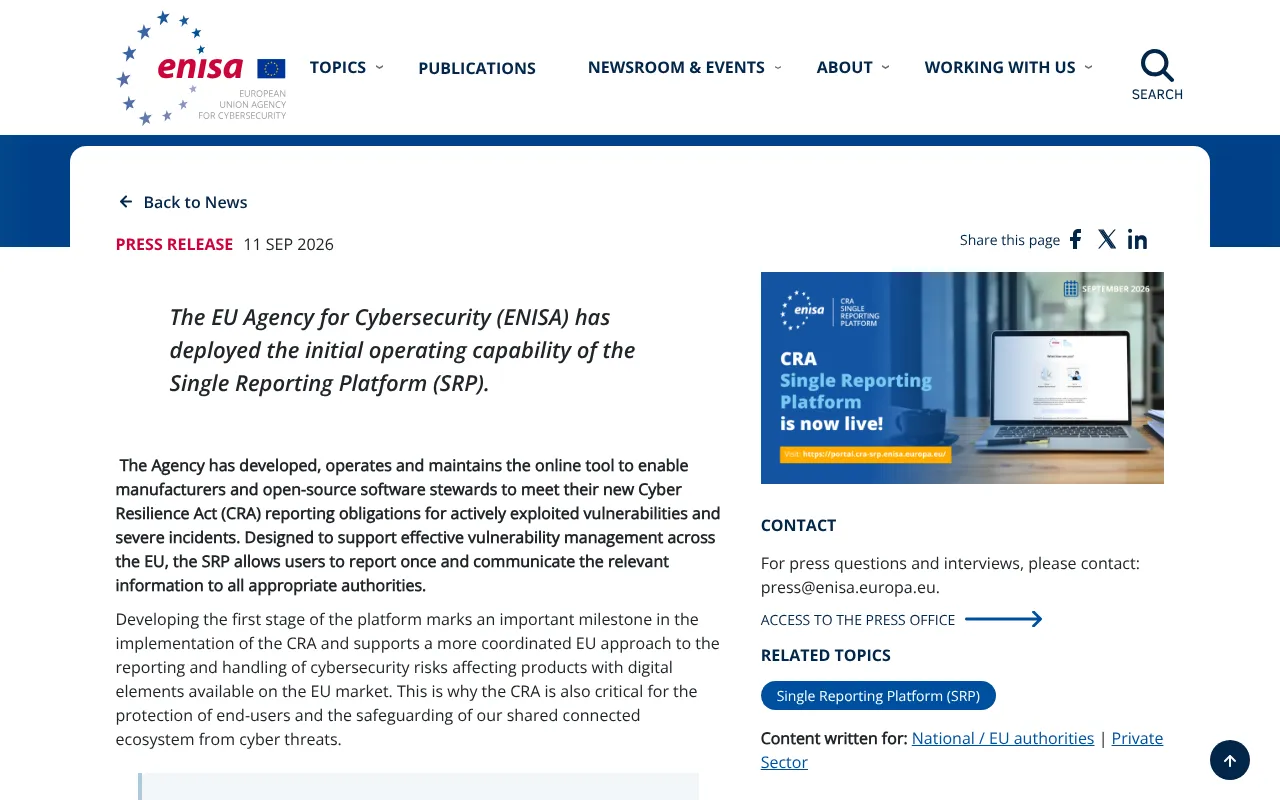
On 11 September 2026, ENISA announced the platform where manufacturers report their exploited vulnerabilities and severe incidents once. Captured on 19 October 2026.
The deadlines are short, according to the Commission’s page on CRA reporting: an early warning within 24 hours of becoming aware, a full notification within 72 hours, then a final report no later than 14 days after a corrective measure is available for an exploited vulnerability, or within a month for a severe incident. The essential cybersecurity requirements apply from 11 December 2027, ENISA notes.
NIS2, the directive that extends cybersecurity obligations to thousands of entities in 18 sectors, has still not been transposed in France: the National Assembly removed the Resilience bill from its agenda on 6 October 2026. Where the text stands, and what you can do without waiting for it, is in our update on NIS2 in France.
Products: software and machinery
Two product texts change things for anyone who manufactures or publishes:
- 9 December 2026: Directive (EU) 2024/2853 on liability for defective products must be transposed, and covers products placed on the market after that date; its definition of a product expressly includes software, according to Gibson Dunn.
- 20 January 2027: Regulation (EU) 2023/1230 on machinery applies on a mandatory basis, with provisions for machinery whose safety functions rely on AI, according to the European Commission.
Data and cloud: the Data Act in three steps
The Data Act has applied since 12 September 2025. Two steps follow, according to McCann FitzGerald’s analysis:
- 12 September 2026: a connected product placed on the market from this date must be designed so that its user can access its data; the obligation is not retroactive.
- 12 January 2027: cloud switching charges disappear. Since 11 January 2024, they could already not exceed the costs directly linked to the switch, under Article 29 of the regulation.
For a business considering leaving a host, this date removes a cost argument, not the migration work. The method is in cloud migration without breaking everything, and the dependency question in can Europe do without the American cloud giants.
French e-invoicing: September 2026, then September 2027
Since 1 September 2026, every VAT-registered business in France must be able to receive electronic invoices, but only large companies, mid-caps and public bodies issue them. According to the French tax administration’s FAQ, the issuing obligation “will be extended to medium, small and very small businesses” by 1 September 2027 at the latest, together with the transmission of invoicing and payment data to the administration.
Outside Europe: two US states to watch
A European business with customers or employees in the United States may fall under the law of the state concerned, since there is no federal AI law. Two dates are close:
- Colorado, 1 January 2027: SB 26-189 requires users of automated decision-making technology to inform consumers and, after an adverse decision, to explain the tool’s role; HB 26-1263 regulates conversational chatbots. Both take effect the same day, according to the Colorado Attorney General’s page, whose office is finalising the implementing rules.
- California, 1 July 2027: SB 947 prohibits disciplining or dismissing an employee based solely on an automated system. Its content is detailed in the human role in the face of AI judgment.
What changes precisely around New Year, from Colorado to the Machinery Regulation, has its own article: what changes on 1 January 2027 for digital.
What concerns you, depending on what you do
Not every date applies to every business. Five situations, in the order they come up most often:
- You use generative AI tools: 2 December 2026 (check that your tools mark their content, disclose your deepfakes), then 2 December 2027 if a use touches recruitment, staff or credit.
- You buy cloud services: 12 January 2027, end of switching charges.
- You publish software, an app or a connected device: CRA reporting since 11 September 2026, security requirements on 11 December 2027, new product liability for what you place on the market after 9 December 2026.
- You are in one of the 18 NIS2 sectors, from 50 people: no date in France, but a reference framework from the French cybersecurity agency ANSSI is already published.
- You are a French SME: issuing e-invoices by 1 September 2027 at the latest.
For AI uses, the overall approach, from the tool inventory to the usage policy, is in our guide to integrating AI in your business.
From the field
Every date on this page was checked on 19 October 2026 against its official source: the Commission’s service desk for the AI Act, ENISA and the Commission for the CRA, the French tax administration for e-invoicing, the Colorado Attorney General. Like every article on this blog, the page starts as a draft and is only published after a human review; each update will be dated at the top.
To find out which of your AI uses come close to high risk and which can stay with a provider, our AI at the right cost offer starts from your actual tools. The rest of the month’s news, from Meta’s terms on crawling websites to new models, is in our October AI news for business leaders.
Frequently asked questions
What is the next AI Act deadline?
2 December 2026. Generative tools placed on the market before 2 August 2026 must have implemented machine-readable marking of their content, and two prohibitions start to apply: generating intimate images of a person without consent and generating child sexual abuse material. The Article 50 transparency obligations have applied since 2 August 2026.
When do the high-risk AI rules apply?
On 2 December 2027 for Annex III uses, including recruitment, staff management and credit scoring, and on 2 August 2028 for AI built into already regulated products. These dates result from the revision adopted in July 2026; the original text set them at 2 August 2026 and 2 August 2027.
Does the Data Act abolish cloud exit fees?
Yes for switching charges: from 12 January 2027, a cloud provider can no longer charge for the switching process. Since January 2024, they were already limited to costs directly linked to the switch. The cost of the migration work itself, on the customer’s side, still has to be planned.
When must a French SME issue electronic invoices?
By 1 September 2027 at the latest. Since 1 September 2026, it must already be able to receive them, whatever its size. Large companies and mid-caps have issued them since 1 September 2026. The obligation comes with the transmission of invoicing and payment data to the tax administration.
Sources
- The Commission’s service desk (new tab)ai-act-service-desk.ec.europa.eu
- The Commission’s page on CRA reporting (new tab)digital-strategy.ec.europa.eu
- ENISA notes (new tab)enisa.europa.eu
- Gibson Dunn (new tab)gibsondunn.com
- The European Commission (new tab)single-market-economy.ec.europa.eu
- McCann FitzGerald’s analysis (new tab)mccannfitzgerald.com
- The French tax administration’s FAQ (new tab)impots.gouv.fr
- The Colorado Attorney General’s page (new tab)coag.gov
Jim · founder of Brain Plus AI
Also in business ai

Understand7 min
Digital Omnibus: what changed in the AI Act
Regulation (EU) 2026/1744, in force since 27 July 2026, revised the AI Act: high-risk rules postponed, AI literacy relaxed, two more prohibitions, relief extended to mid-sized companies. What changes, what does not, and the updated timetable.
Practical guide10 min
AI Act and GDPR: what an SME using AI must do
An SME that uses ChatGPT or a CRM with built-in AI already has obligations. This guide takes stock in October 2026: your role under the AI Act, the timetable revised in July 2026, what the GDPR requires and the steps to get compliant.

Practical guide7 min
AI-generated content: mandatory marking by 2 December
Since 2 August 2026, the AI Act requires images, video, audio and text generated by AI to be marked, and tools already on the market have until 2 December 2026 to comply. Who marks, who discloses, what the European code of practice recommends and what a detector really proves.