
Contents6
For years I have used the same image with clients: marketing is a wheel, and each channel is a spoke. When the budget is tight, the reflex is to remove a whole spoke: “we do SEO, no ads”, or “we stick to organic social, it costs nothing”. I advise the opposite: make the wheel smaller, but keep every spoke.
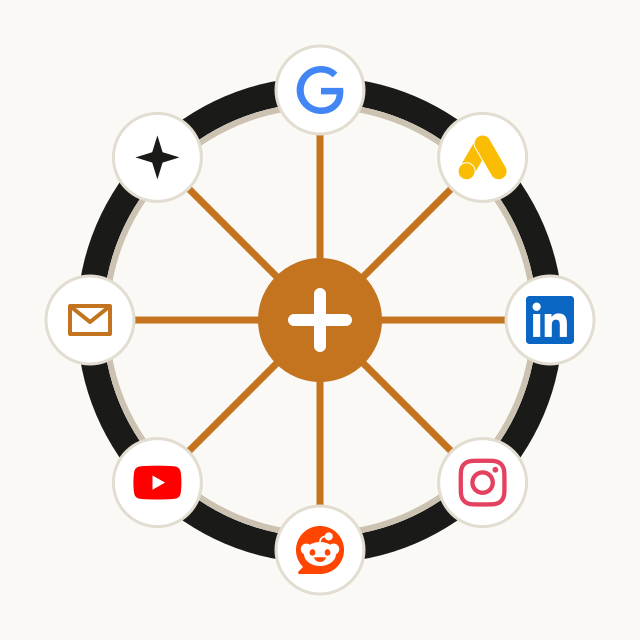
The channel wheel: organic search, ads, social media, email and AI engines. Remove one spoke and the whole wheel goes off balance.
The old split no longer holds
Five or ten years ago, social media had no real weight on organic search. It was a useful acquisition channel, but a separate one. You could think channel by channel without being far off.
That is no longer true. Google now shows content from LinkedIn, Reddit or Instagram on many results pages. And AI engines are more likely to cite strong brands, the ones found everywhere on the web, social media included. A brand missing from social networks therefore also loses visibility in search, classic and generative alike. We cover that last point in our article on getting cited by ChatGPT and AI engines.
SEO specialists say it more and more: social networks have become search engines in their own right. People look for answers there, compare solutions and discover products. And AI engines rely heavily on classic search and on the brands they see cited: the more a brand is mentioned, the more likely it is to appear in an answer. Three practical consequences:
- start from the need: each post answers a precise question and makes sense without context, like a blog page;
- get people talking: reply to comments, cite other players, get cited in return, so that search engines and AI clearly identify the brand, its leaders and its field;
- break the silos: website, social networks, newsletter and events tell the same story and point to one another.
Social media and SEO remain two different jobs. But a team that makes them work together wins on both fronts.
Why companies cut a spoke
I see it often: a company wants to separate SEO from paid search, or focus on one channel at a time. The reason is almost always budget. That is understandable, and it is a mistake, because channels do not just add up. They inform each other.
What one channel teaches the others
The example I give most is Google advertising. It shows the exact words people typed before clicking an ad. Not an estimate, not an average volume: the real phrase. That is a goldmine for the rest of the wheel:
- blog topics that answer real questions;
- new pages for needs you were not covering;
- services or products to improve, and arguments for the sales team.
SEO turns those findings into pages that keep working over time, without paying for each click. Social media tests an angle in a few days and gives the brand the broad presence Google and AI engines reward. Cutting ads therefore also deprives SEO of its best ideas. Knowing which channel actually triggered a sale helps you dose each one: that is the subject of our article on marketing attribution.
What each channel costs, and what it brings
Each spoke is paid for differently. The amounts depend too much on the sector to be given here, but the nature of the spending does not change:
| Channel | What you pay for | What it brings | Time to results |
|---|---|---|---|
| SEO | Writing and technical time, paid once then maintained | Lasting visits without paying per click, and the base AI engines draw on | Several months |
| Google Ads (paid search) | Each click, plus management time | Immediate visits and the exact words customers type | A few days |
| Organic social media | Time: writing, posting, replying | Awareness, conversations, mentions of the brand | Several weeks |
| Social media ads | Each impression or click | Reaching a precise audience (job, sector, company size) and testing a message fast | A few days |
| A sending tool and writing time | Staying in touch with people who already know you, at a low cost per send | Immediate, on an existing list | |
| AI engines (GEO) | Nothing direct: it is the result of the other spokes | Being cited in answers from ChatGPT, Gemini or Google’s AI Overviews | Long, and hard to predict |
The table says one thing above all: paid channels buy speed and data, organic channels build capital. You need both.
What budget for a smaller wheel
It is the question I always get, and the honest answer is that a figure without knowing the company is not worth much. My benchmark: below €500 a month across all channels, it is very hard to draw conclusions, for lack of data. Starting around €1,000 a month is a good base.
That benchmark then moves with three things:
- the sector and the competition: in some fiercely contested sectors, a click on a keyword costs a small fortune;
- the margin on products and services, which tells you how much you can pay for a customer;
- the starting point: a site that already ranks well or a known brand does not have the same needs.
To place that amount within your overall spending, see what share of revenue to spend on marketing.
Our view
A single channel pushed hard gives fragile results and few lessons. Several channels kept at a small scale reinforce each other, and the data from one steers the others. With AI engines drawing from everywhere, this wheel logic becomes the rule rather than an option.
Jim · founder of Brain Plus AI
Also in digital marketing

Practical guide7 min
How to get cited by ChatGPT and AI search engines
What actually gets a site cited by ChatGPT, Claude or Perplexity: let the bots read it, answer straight away, source every fact, mark up only what is shown. And how to measure it without fooling yourself.

Understand7 min
Marketing attribution: which channel really sold
A B2B sale goes through several channels over several weeks, and every tool claims it. Marketing attribution shares the credit between them; in B2B, it holds when each contact's source is recorded in the CRM and tied to the signed sale.

Choose and price7 min
B2B marketing budget: what share of revenue?
2026 surveys put the marketing budget of B2B companies between 7 and 10% of revenue. That benchmark helps you see where you stand, but the right budget is built from the sales you are aiming for and from what each channel actually brought in.