
Contents6
Amazon draws buyers that an online store would take years to attract. That is the argument that leads many teams to open a seller account alongside their own website. The argument is right, but it says nothing about what matters most: what is left after each sale, what happens to stock when two channels empty it at the same time, and what you accept no longer deciding yourself.
This guide is for teams that already sell online and wonder whether Amazon should become a second channel. It does not tell you whether to go: it gives you the three calculations to make first.
In short
A sale on Amazon pays a subscription, referral fees that depend on the category and, depending on the option chosen, Amazon’s logistics.
Margin is worked out product by product: some items can carry the fee, others cannot.
Two channels drawing on the same stock require reliable syncing; Amazon penalises orders cancelled for lack of stock.
Amazon’s customers remain Amazon’s: your own store is where the relationship is built.
What a sale on Amazon costs
Amazon’s pricing page sums it up in one sentence: the cost depends on your selling plan, your product category, your fulfilment strategy and other variables.
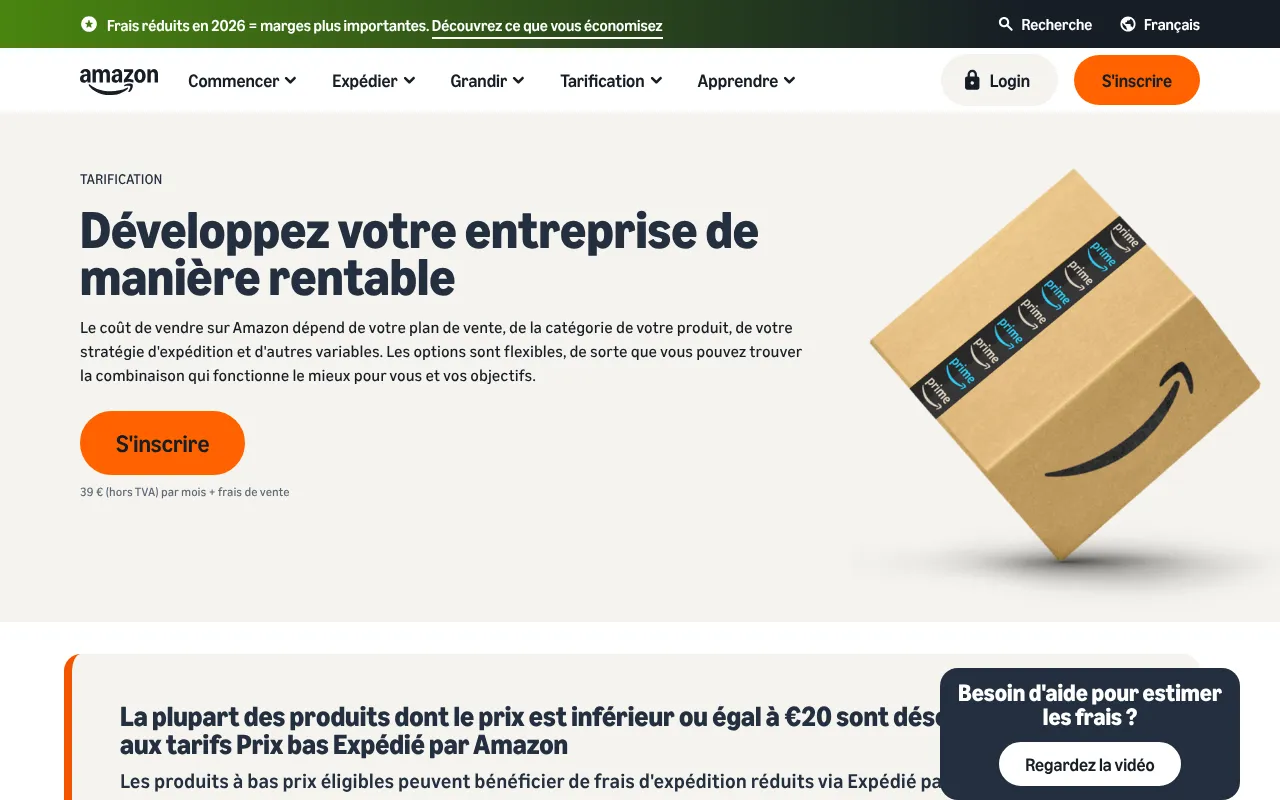
Amazon’s pricing page for sellers in France: the subscription is shown upfront, referral fees depend on the category. Captured on 19 October 2026.
The amounts published on Amazon.fr give the order of magnitude:
per month excluding VAT for the Professional plan, whatever the number of items sold
referral fees for most categories, with a minimum per item
after delivery: the default payment delay for the seller
Logistics come on top. With Fulfilment by Amazon, Amazon stores and ships for you, in exchange for fulfilment and storage fees. Shipping yourself, you keep those costs but also the burden of meeting delivery times.
These fees change every year. Amazon says so in its December 2025 announcement on European fees for 2026:
Near the end of each year, we provide our selling partners with an update on changes.
The same announcement plans an average fee reduction per unit sold in Europe, but also selective increases on monthly storage, return-to-seller and liquidation fees. A margin calculation done once and for all does not hold: it has to be redone with each new schedule.
Margin, product by product
Revenue made on Amazon always looks good. What counts is what is left per product once you deduct the purchase cost, referral fees, logistics, returns and any advertising on the platform.
What is left of a sale on Amazon
- The selling price
What the buyer pays, often against other sellers.
- Referral fees
A percentage by category, with a minimum.
- Logistics
Fulfilment by Amazon, or your own shipping.
- The margin
What is left after product cost and returns.
This calculation sorts the catalogue quickly. An expensive, light item often carries the fee; a cheap, bulky item can lose all of it to logistics. The right starting point is the margin you already track on your store, among the five numbers to track every week, with the cost of goods filled in. Count returns too: on a marketplace as elsewhere, they weigh more than people think, and our article on product returns details that cost.
From the field
On an online plush toy store that we are putting back on its feet, no channel decision was made before rebuilding the history: 71 months of sales and 1,036 orders, without reading a single piece of personal data, then the real margin per product, payment fees included. That table is what tells you which products would carry one more fee, and which would not.
Stock: shared, or handed to Amazon
Selling on two channels means emptying the same stock through two doors. Two set-ups are possible, with no universal winner:
You ship yourself
One stock for the store and Amazon
Quantity syncing is essential
Your delivery times and packaging, under Amazon’s scrutiny
Fulfilment by Amazon
Part of the stock sent to Amazon’s warehouses
Storage and fulfilment fees on top of referral fees
Two stocks to track, and to replenish separately
In the first case, a store sale that is not deducted on Amazon in time ends up as a cancelled order. Amazon measures it, and says so in its seller help:
We require sellers to maintain a CR less than 2.5% to sell in the Amazon store.
Beyond that, the same page provides for the suspension of seller-fulfilled selling privileges or the deactivation of the offers concerned. How to keep stock accurate across channels is the subject of our article on inventory sync. And if the tool linking your store to Amazon is one more app, weigh it like the others, with our method for Shopify apps.
Dependency: what you no longer decide
On Amazon, you sell in someone else’s store. Three consequences deserve a hard look before opening the account.
- The competition is on the same page. According to Amazon’s seller site, small and medium-sized businesses account for more than half of the units sold in its stores. Your product appears next to other offers, price first.
- Rules and fees change without you. The schedule changes every year, as do the visibility rules.
- Customers remain Amazon’s. Its seller code of conduct is explicit.
You may not attempt to circumvent the Amazon sales process or divert Amazon customers to another website.
The same text limits the use of the addresses you receive to fulfilling orders, and prohibits marketing communications. In other words, following up with a customer, asking for a review on your own site or sending a repeat-purchase email remain levers of your own store: abandoned cart reminders and collecting customer reviews are built there, not on the marketplace.
Key takeaway
Amazon is a sales channel, your store is an asset
What you sell on Amazon brings a margin; what you sell on your store also brings a customer you can see again. A good balance keeps the store as the destination, and Amazon as an extra channel.
Where to start
- Work out the margin per product.
Category referral fees, logistics, returns: the list of products that can carry the fee comes out of this calculation.
- Test a short selection.
A few profitable references, rather than the whole catalogue at once.
- Choose who ships.
Your own shipping with shared stock, or Fulfilment by Amazon with separate stock.
- Connect stock to a single source.
The store or the ERP, from which quantities go out to each channel.
- Review after a quarter.
Real margin, cancellations, returns, and the share of sales that moved from your store to Amazon.
Product data, for its part, serves both channels: a clean catalogue, with verified identifiers and GTINs, is the common base described in our guide to preparing your store for Google Shopping and marketplaces, and a page that answers the buyer’s questions sells on both, as explained in our article on the product page that converts. Amazon sells in several European countries: opening other languages raises the questions of the multilingual, multi-currency store. Finally, compare this channel with other paid sources, starting with a Google Shopping campaign, and with the platform choice itself, discussed in Shopify or Medusa.
If you want to run this calculation on your catalogue before opening a seller account, our ecommerce service starts with your data: margins, stock and channels.
Frequently asked questions
How much does selling on Amazon cost a store?
On Amazon.fr, the Professional plan costs €39 per month excluding VAT, plus referral fees of 8 to 15% for most categories, with a minimum per item. Logistics come on top: your own shipping, or Fulfilment by Amazon fees. The amounts change every year, so check them when you decide.
Is it better to ship yourself or use Fulfilment by Amazon?
It depends on volume, product format and your current logistics. Shipping yourself keeps a single stock but requires delivery times you can meet and reliable syncing. Fulfilment by Amazon takes shipping off your hands in exchange for storage and fulfilment fees, with a separate stock to replenish. Compare the margin per product in both cases.
Does selling on Amazon reduce sales on your own store?
It can, if the same products are cheaper or better placed there and your regular customers move over. Track each channel’s share of sales and the number of customers who come back to the store. Many teams keep a selection for Amazon, and the full ranges and services for their own site.
Can you bring Amazon customers to your own store?
Not through the platform. Amazon’s seller code of conduct prohibits diverting its customers to another website and limits the use of the addresses received to fulfilling orders. What brings a buyer back to your brand is the product, the packaging and the service; the direct relationship is built with your own store’s customers.
Jim · founder of Brain Plus AI
Also in e-commerce

Practical guide7 min
Inventory sync across your store, marketplaces and shop
When an online store, a marketplace and a physical shop draw on the same stock, the last unit ends up sold twice one day. What reliable syncing requires: a single source of truth, well-defined quantities, a safety margin and an alert when things drift.

Practical guide8 min
Google Shopping and marketplaces: preparing your store
Before listing a catalogue on Google Shopping or a marketplace, you need clean product data: identifiers, titles, prices, availability, shipping and returns. What Google Merchant Center asks for, and why it is the same foundation for every channel.

Practical guide6 min
Online store: five numbers to track every week
An online store dashboard shows dozens of metrics; five are enough to decide every Monday. Which ones, how to read them together, and what each one prompts you to do.