
Contents6
A disappointing campaign almost always triggers the same moves: rewrite the ads, change the bid strategy, raise or cut the budget. Rarely does anyone open the page the clicks land on, on a phone, through the eyes of someone who has just read the ad. Yet that is where half the result is decided: the ad brings a visitor, the landing page decides whether they become an enquiry. This article is part of our online advertising guides.
In short
Google scores the landing page in Quality Score, alongside the ad and expected click-through rate.
Its policies reject destinations that are hard to navigate, slow or blocked by pop-ups.
A good page repeats the ad’s promise, answers the questions people have before buying and makes enquiring easy.
Before raising a budget, test the page on a real phone, form included.
What Google looks at on your page
Google Ads Quality Score has three components: expected click-through rate, ad relevance and landing page experience, defined as how relevant and useful your landing page is to people who click your ad. Google states that Quality Score, rated from 1 to 10, is not used in the ad auction: it is a diagnostic tool. But it shows where the account loses points, and the page is a third of it.
Beyond the score, Google sets rules. Its destination experience policy requires the page to work on common browsers and devices:
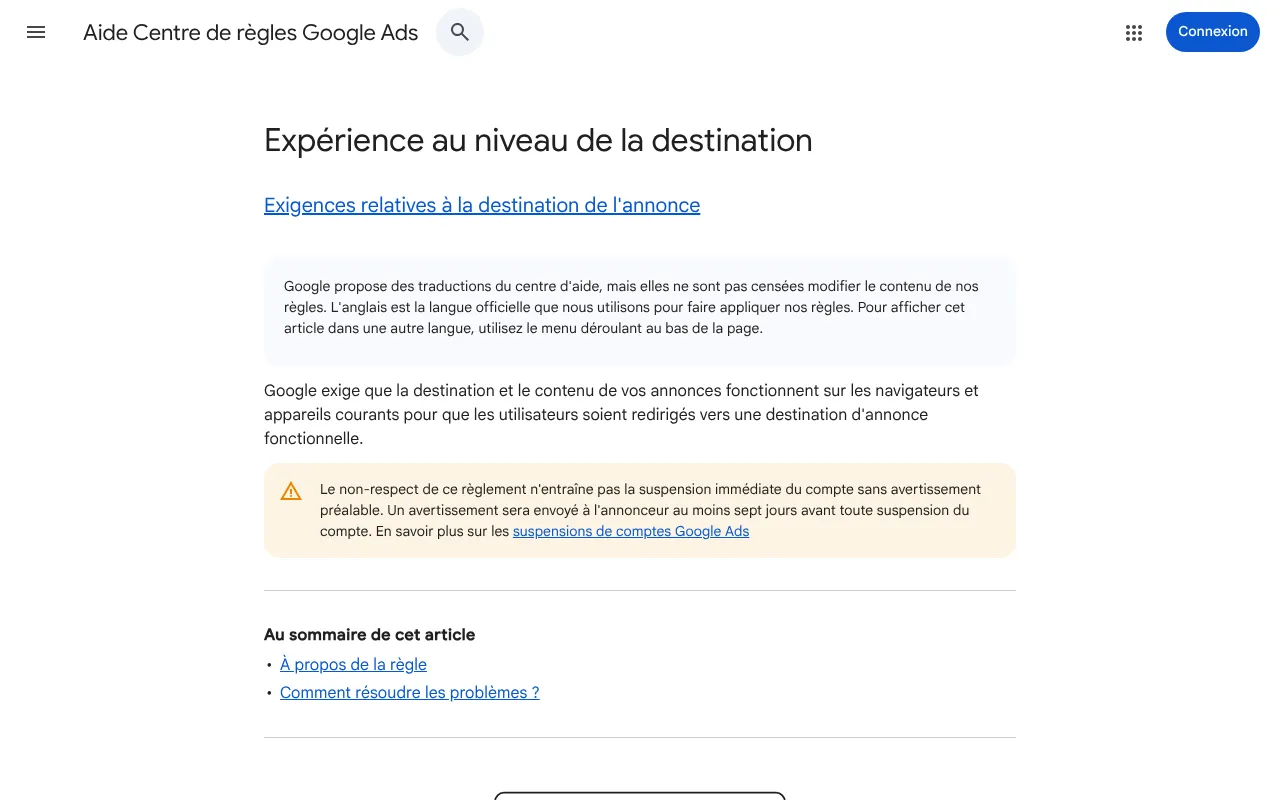
The “Destination experience” policy in the Google Ads Policy Centre, shown here in French: ad destinations and content must work on common browsers and devices. Captured on 19 October 2026.
That policy lists among rejected destinations sites with pop-ups or interstitials that stop users from seeing the content they wanted, sites that disable or interfere with the browser’s back button, sites that do not load quickly on most popular browsers and devices, and sites that require downloading an extra application. A page that ticks one of those boxes does not just cost sales: it can get the ad disapproved.
Why speed weighs so much
A visitor from an ad has not yet decided to trust you. Every second of waiting on a phone gives them a reason to go back to the results.
faster on a mobile site, the improvement the study measured
more conversions for retail sites in that study
more conversions for travel sites
These figures come from large retail and travel brands, not B2B sites: they give a direction, not a promise. The direction is clear, and it holds on sites we know well. On Palmora Property, a property listings site we work with, the main content took 10.1 seconds to display on mobile when its speed was diagnosed. On an online plush toy shop, the mobile audit measured 8.4 seconds for the same metric, with a 4.2 MB page. An ad sending clicks to pages like those pays for part of its visitors to stare at a blank screen.
The ad’s promise, kept by the page
A visitor who clicks on “scheduling software for ambulance services” expects a page about scheduling and ambulances, not the vendor’s general home page. The rule is simple and often forgotten: the page repeats the words of the ad, in its headline and first lines.
A page that converts
The headline repeats the ad’s promise
The price, or what makes it vary, is visible
Proof close to the offer: a case, a sourced figure
A single action requested, easy on a phone
A page that loses the click
The home page, which talks about everything
Promises that contradict each other from page to page
A long form, or one that cannot be used with a keyboard
A pop-up before the content
Consistency goes beyond the page itself. The plush toy shop mentioned above stated delivery times of 10 to 27 working days, 1 to 4 weeks or 8 to 10 working days, depending on the page: a visitor who reads two of those pages no longer knows what to believe, and leaves. It is a conversion problem as much as a legal one.
The form, the last step
Enquiries are often lost at the last move. Palmora Property learned this the hard way: on all its listing pages, the contact form could not be filled in with a keyboard, and the photo gallery intercepted the arrow keys. No campaign could have made up for that flaw, and no advertising dashboard would have shown it. On the same site, a six-step form was cut to five.
The form also has to keep track of the ad that brought the visitor. Since 18 October 2026, every enquiry sent through this site’s form carries the origin of the visit (UTM parameters, landing page, referring site), kept for the browser tab without a cookie and saved before the email goes out. Without that trail, there is no knowing which campaign, and which page, produced which enquiry; our guide to forms on a static site details the set-up, and our guide to sending CRM sales back to Google Ads covers what comes next.
Checks before raising a budget
- Open the page on a real phone
Over 4G, from the ad itself.
- Read the ad, then the page
Is the promise repeated in the headline and first lines?
- Submit the form
By touch and then by keyboard, and check the enquiry arrives with its source.
- Compare pages with each other
Do price, lead times and guarantees say the same thing everywhere?
- Read the page’s score
In Quality Score, keyword by keyword.
These checks take an hour. They change how you read everything else: a test budget sent to a slow page measures the page, not the advertising. Negative keywords keep the wrong visitors out, the page takes care of the right ones. And when Performance Max picks the landing page itself, every page of the site becomes a possible landing page.
The rule holds for every platform: a LinkedIn or Meta ad that sends people to your site depends on the same page. And if you have AI write your pages, reread every promise: an invented lead time or guarantee misleads the visitor before it binds you, a risk that our article on AI and disinformation puts in perspective.
To have your landing pages checked before touching the budget, our digital marketing offer handles the ad, the page and enquiry tracking together.
Frequently asked questions
What is a landing page in advertising?
It is the page a visitor reaches after clicking an ad. It can be an existing page of the site or one built for the campaign. Its job is to keep the ad’s promise and make enquiring easy: a form, a call, a meeting booking.
Do you need a dedicated landing page for each campaign?
Not necessarily one per campaign, but one per promise. If two ads promise the same thing, they can share a page. If one is about scheduling for ambulance services and the other about invoicing, each deserves the page that repeats its words. The home page rarely fits: it talks about everything, so about nothing in particular.
How do you know whether the page or the ad is the problem?
Look at click-through rate and enquiry rate separately. A good click-through rate with few enquiries points to the page: the ad attracts, the page does not convince. A low click-through rate points to the ad or the targeting. Google’s Quality Score, with its landing page experience rating, helps decide keyword by keyword.
Does page speed matter for Google Ads?
Yes, in two ways. Google’s policies reject destinations that do not load quickly on most popular browsers and devices. And a slow page loses visitors before they read anything: you pay for the click without getting the chance to convince.
Sources
- Google Ads Help, about Quality Score (new tab)support.google.com
- Google Ads Policy Centre, destination experience (new tab)support.google.com
Jim · founder of Brain Plus AI
Also in online advertising

Choose and price7 min
Google Ads in B2B: the minimum budget that gives a signal
In B2B, a Google Ads budget that is too small does not just cost little: it tells you nothing. The right minimum comes from your click price, your enquiry rate and the number of enquiries you need to judge.

Practical guide8 min
Send your CRM sales back to Google Ads: the guide
In B2B, the sale is signed weeks after the click, by phone or in a meeting. Until Google Ads knows that, it optimises for submitted forms, not for customers: here is how to send it the stages from your CRM.

Choose and price7 min
LinkedIn Ads: expensive, but who is it worth the price for?
LinkedIn Ads has a reputation for being expensive, because it sells access to a job function, a company and a seniority level. Who that targeting is worth the price for, and how to check before committing a budget.