
Contents6
When an AI answers instead of a results page, advertising follows the answer. In October 2026, two platforms do it at scale: Google in its AI Overviews, OpenAI in ChatGPT. Both promise the ad stays separate from the answer; both leave the advertiser with fewer settings and reports than a classic campaign. Here is what we know, with sources, and what it changes for a business that buys advertising; the article is part of our online advertising guides.
In short
Google: ads above, below or inside AI Overviews, drawn from your existing campaigns, with no dedicated setting.
Inside AI Overviews themselves: English only, twelve countries, no way to opt out, no separate report.
ChatGPT: ads below the answer, on the Free and Go plans, in Europe since late August 2026.
OpenAI states that ads do not influence answers and that conversations stay private from advertisers.
Where things stand in October 2026
- February 2026
OpenAI starts testing ads in ChatGPT in the United States.
- 18 August 2026
OpenAI announces ads in 31 European markets, including France, from the following week.
- 16 October 2026
List-based targeting (emails, phone numbers) exists in the United States, not yet in Europe.
- 19 October 2026
Google Ads Help lists twelve countries where ads show inside AI Overviews, all in English.
Ads in answers are therefore no longer a marginal test. They are still young, though: both platforms document what they show, much less what they measure.
At Google: your campaigns, with no switch
Google distinguishes two placements. Ads above and below AI Overviews are possible in every market where the overviews exist. Ads inside the AI Overview are more limited:
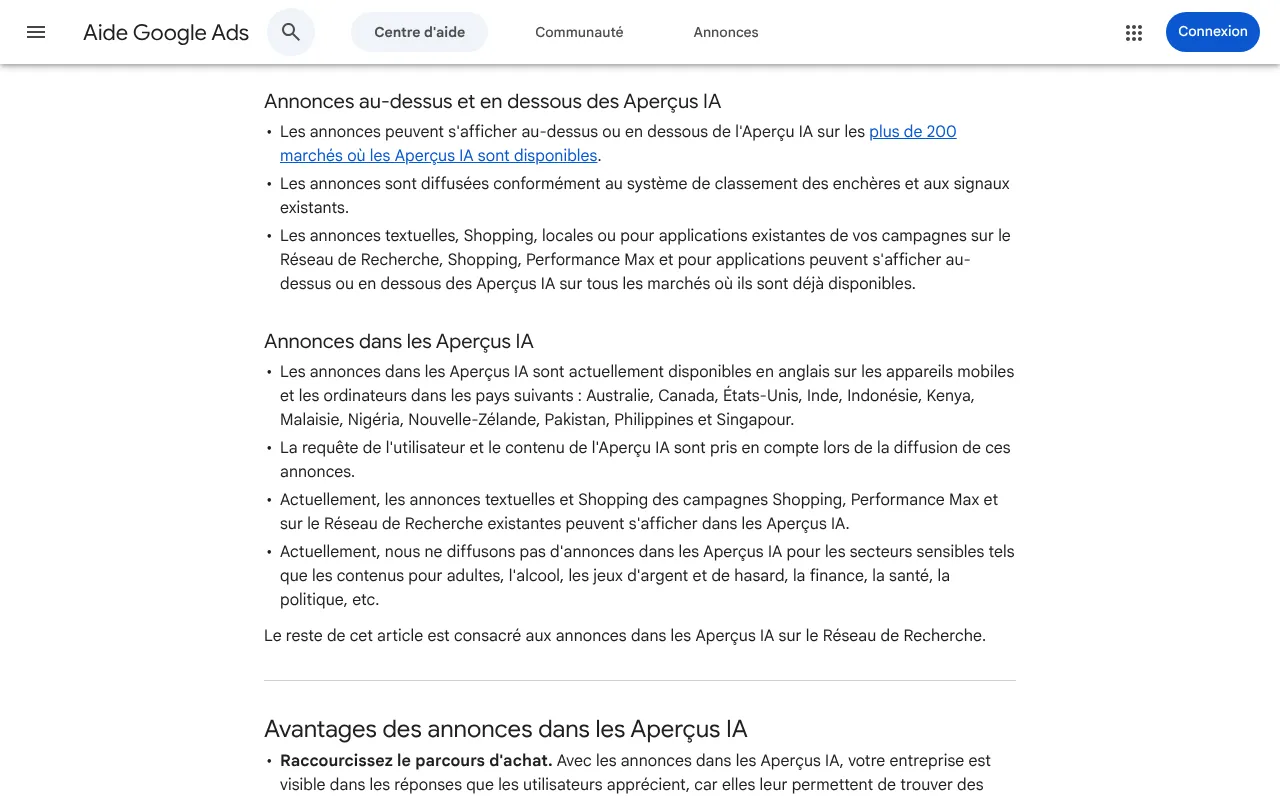
The Google Ads help page “About ads and AI Overviews” (French version shown): twelve countries for ads inside the overviews, in English, and no ads for finance, health, politics or gambling. Captured on 19 October 2026.
The rest of that help page says what matters to an advertiser:
- ads come from your existing campaigns (Search, Shopping, Performance Max); Google considers both the query and the content of the AI Overview when choosing them;
- Google recommends broad targeting to appear there: broad match, AI Max, Performance Max or Dynamic Search Ads, because these overviews trigger on complex questions few advertisers target with keywords;
- you can neither target this placement alone nor opt out of it;
- there is no separate report: these ads are counted as top ads.
For a small business, the consequence is concrete. You do not buy “AI Overviews”: you broaden your targeting, and part of the budget goes to questions further from purchase, with no way to isolate what they bring in. It is the same logic as Performance Max, and the same discipline applies: negative keywords every week, and a test long enough to give a signal.
At ChatGPT: a new ad platform
OpenAI set out its principles when the test launched, in its February 2026 announcement:
- answer independence: ads do not influence what ChatGPT answers, and they are labelled as sponsored and visually separated from the answer;
- no ads for users under 18, whether declared or predicted;
- no ads near sensitive or regulated topics, such as health, mental health or politics;
- conversations stay private: advertisers only receive aggregate data, such as the number of views or clicks;
- only the Free and Go plans show ads; Plus, Pro, Business, Enterprise and Education do not.
The expansion to Europe was announced on 18 August 2026: according to The Next Web, 31 markets, including France, Germany, Spain and Italy, with buying first through OpenAI’s sales team and its partner agencies.
Targeting is different from a keyword. According to Next, the advertiser describes the conversations or topics relevant to its offer, hints that are not exact-match rules. Audiences built from lists of emails or phone numbers exist in the United States, but not yet in France or the rest of Europe.
Google, inside AI Overviews
Your existing campaigns, no dedicated campaign
Broad targeting recommended, placement not targetable
No separate report, no opt-out
Ads inside overviews: English, twelve countries
ChatGPT, below the answer
A separate platform, with its own campaigns
Context hints rather than keywords
Aggregated reports, conversations not shared
Free and Go plans, Europe since late August 2026
What it changes for an advertiser
Measurement goes through your site
Neither platform shows you the conversation. What you can measure is what happens on your side: the landing page, the campaign parameters, the enquiry sent, then the sale.
From the field
On this site, every enquiry says where the visit came from since 18 October 2026
The contact form on brainplusai.com stores with each enquiry the campaign parameters, the landing page and the referring site of the visit. An enquiry that came from an AI assistant, paid or not, can usually be recognised by its source, then followed to the contract in the CRM.
That is what lets you compare these placements with others on the only figure that counts, customer acquisition cost, rather than on views. Sales sent back from the CRM, described in our offline conversions guide, also work for Google; OpenAI has announced its own measurement tools, to be assessed once they are available to you.
The ad must keep the answer’s promise
An ad that appears below a detailed answer is read by someone who has just compared. The landing page must answer with the same precision: prices, lead times, proof. Our article on the landing page details what it should contain. And if the copy is generated, it gets reviewed: what works with AI-generated ads applies here more than anywhere, as does the question of trust raised in our article on AI and disinformation.
Being cited remains distinct from being advertised
Advertising does not buy a place in the answer itself. Being cited as a source is a matter of search optimisation: see how to get cited by ChatGPT and what AI Overviews do to your traffic. The two complement each other: the ad buys immediate visibility, the citation is built over time.
Should you go now?
For most B2B small businesses, there is no separate decision to make at Google: your search and Performance Max campaigns are already eligible if you target broadly, and the real choice is about broadening your targeting. At ChatGPT, it is one more platform to test, with a dedicated test budget and measurement in place before the first spend, as for any new channel: the method in our Google Ads or Meta comparison applies, and LinkedIn Ads remains more direct if your buyers are defined by their job title.
Two last precautions. The customer lists you hand to a platform fall under the same consent rules as retargeting without third-party cookies. And if an agency buys these placements for you, its contract should say how it reports on them. To decide whether these placements deserve a share of your budget, our digital marketing offer starts by measuring your current enquiries.
Frequently asked questions
Can you advertise in ChatGPT in Europe?
Yes: on 18 August 2026, OpenAI announced ads in 31 European markets, including France, Germany, Spain and Italy, on the Free and Go plans. Buying went first through OpenAI’s sales team and its partners. According to Next, targeting based on lists of emails or phone numbers was not yet active in Europe in mid-October 2026.
Do ads influence ChatGPT’s answers?
OpenAI says not: according to the principles it published in February 2026, ads do not influence answers, are labelled as sponsored and are visually separated from the answer. Advertisers have no access to conversations, only to aggregate data. It is a company commitment that nothing allows outsiders to verify.
Can you choose whether to appear in Google’s AI Overviews?
No. According to Google Ads Help, you can neither target this placement alone nor opt out of it: your Search, Shopping and Performance Max ads are eligible if they win the auction and match both the query and the content of the overview. Ads inside the overviews only exist in English, in twelve countries.
How do you measure the results of an ad in an AI answer?
On your site and in your CRM. Google offers no separate report for ads inside AI Overviews, and OpenAI only shares aggregate data. Record the source of each enquiry (campaign parameters, landing page, referring site), then follow it to the sale to calculate an acquisition cost comparable with other channels.
Sources
- Google Ads Help, about ads and AI Overviews (new tab)support.google.com
- OpenAI, Testing ads in ChatGPT (new tab)openai.com
- The Next Web, OpenAI is bringing ChatGPT ads to 31 European countries, 20 August 2026 (new tab)thenextweb.com
- Next, La publicité ciblée de ChatGPT peut utiliser prompts, emails et numéros de téléphone, 16 October 2026 (new tab)next.ink
The Next Web, OpenAI is bringing ChatGPT ads to 31 European countries, 20 August 2026
Read on thenextweb.com(new tab)Next, La publicité ciblée de ChatGPT peut utiliser prompts, emails et numéros de téléphone, 16 October 2026
Read on next.ink(new tab)Jim · founder of Brain Plus AI
Also in online advertising

Understand6 min
Performance Max: what the automated campaign hides
Performance Max buys across all of Google from a single campaign, and decides on its own about channels, pages and part of the copy. What Google now shows, what you still have to check yourself, and when to hand it a budget.
Understand7 min
Advertising and AI: generated copy and visuals, what works
Ad platforms now generate headlines, descriptions and images from your website, and any assistant writes ten variants in a minute. What AI does well in an ad, what still needs a human read, and which images must be disclosed.

Choose and price7 min
Google Ads or Meta for a B2B SME: how to choose
Google Ads answers a search, Meta interrupts a news feed. In B2B, that difference decides which platform to start with, and how to judge the test.