
Contents7
Writing fifteen ad headlines used to take a morning; an AI suggests thirty in a minute, and the ad platform itself generates images from your website. The question is no longer whether AI can produce an ad, but which of its suggestions deserve to run under your name. This article sorts what saves time from what costs trust; it is part of our online advertising guides.
In short
AI excels at variation: headline variants, image formats, languages, starting from a message that is already right.
It knows neither your lead times, nor your prices, nor your guarantees: anything that commits you gets reviewed.
A realistic generated image that could pass for a real photo must be disclosed (AI Act).
A generated variant is tested against the existing one and judged on qualified enquiries.
What ad platforms already offer
Google Ads builds generation into campaign creation. According to its Performance Max help page, its AI starts from your page address, summarises the offer, then generates headlines, descriptions and long headlines, and suggests images, including bespoke generated ones. It can also create images with people, adults only. Generation is optional, and every suggested asset can be discarded.
The same page states its limits plainly:
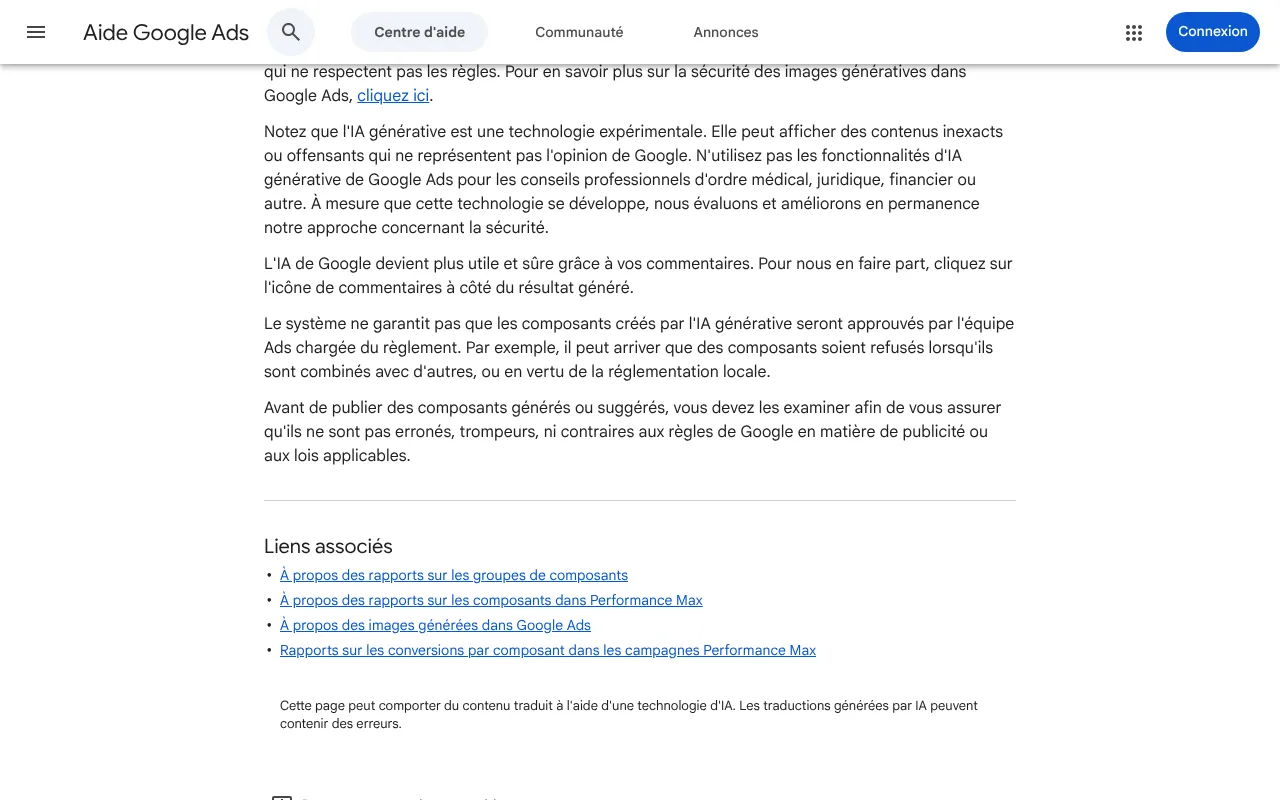
The “AI responsibility” section of Google Ads Help (French version shown): generative AI “may display inaccurate content”, and the advertiser should review generated assets before publishing them. Captured on 19 October 2026.
Outside the platforms, any general-purpose assistant (ChatGPT, Claude, Gemini, Mistral’s Le Chat) writes ad variants. The choice of tool matters less than how you use it: what you give it to read, and what you review on the way out.
What works
Varying a message that is already right
AI is at its best when the substance is fixed and has to be said twenty ways. A Search ad accepts several headlines and descriptions that Google combines; finding fifteen distinct headlines that carry the same promise is exactly the job where a language model saves time. Give it the landing page, the real proof points and the forbidden words, not a vague instruction.
Changing format
Cropping a visual for square, banner and story formats, or placing a product image on several backgrounds: that is production work, not creation, and generation does it fast. The product shown must remain the real product.
Changing language, with review
Translating ads and their pages costs little with a well-chosen model. On Palmora Property, a real-estate portal in six languages that we work with, switching to a suitable AI model divided the translation cost by 60, and 95% of segments now come from the cache. A translated ad still needs a review by someone who knows the market: a promise that sounds right in one language can sound wrong in another.
What does not work
What AI does well
Turning one promise into dozens of variants
Adapting a visual to several formats
Suggesting angles you had not tried
Translating a message already approved
What stays human
Saying what you really deliver, and how fast
Choosing the promise that sets you apart
Deciding whether an image could pass for a real photo
Judging a variant on qualified enquiries
Invented promises
A model fills gaps with what is likely. If your page gives no lead time, it may write one; if your competitors promise a guarantee, it may attribute one to you. Google acknowledges it on the page captured above: generated assets are not guaranteed to be approved, and it is the advertiser’s job to check they are neither inaccurate nor misleading. A false ad costs twice: in clicks paid for nothing, then in trust, which our article on AI and disinformation explores beyond advertising.
Ads that all look alike
Models converge on the most likely wording. If a whole industry generates its ads with the same tools and the same instructions, the ads end up looking alike, and the buyer no longer sees a difference. The promise that sets you apart comes from you: your proof, your customers, what you refuse to do.
Campaigns that generate while nobody looks
In Performance Max, Google can also compose copy and choose landing pages. These assets are now visible in reports: review them every week, like any text that goes out under your name. And check the page that receives the click: a brilliant ad that leads to a page that does not keep its promise loses the visitor, as our article on the landing page explains.
Generated images: what must be disclosed
Article 50 of the AI Act has applied since 2 August 2026. It requires the tool that generates an image to mark it in a machine-readable format, and the business that publishes a deepfake to disclose it: a generated image, sound or video that could pass for authentic, showing real people, places or events.
Definition
Deepfake
An image, sound or video generated or manipulated by AI that resembles real people, places or events and could falsely appear authentic.
For an ad, the practical rule fits in one question: could a reader believe it is a real photo? A clearly drawn illustration is not one; a fake smiling customer in a fake office is. The question for text is close and covered in our article on AI-written text.
From the field
This blog’s covers are drawn in code, never generated
Since 12 October 2026, every article cover on this site is a vector drawing written in code, with no generated image: none can pass for a photo. The choice has a cost (every drawing has to be written) and a benefit: nobody wonders whether the image tells the truth.
Testing a generated variant
A generated variant is a hypothesis, not an improvement. Google Ads lets you set up a custom experiment that splits traffic between the original campaign and a modified version.
- Fix the substance.
The promise, the proof, the forbidden words, written by you.
- Generate wide.
Headline and visual variants, with the tool of your choice.
- Review tight.
Anything that commits you (prices, lead times, guarantees, results) is checked or removed.
- Test against what runs.
One test at a time, judged on qualified enquiries, not clicks.
Judging on qualified enquiries means measuring them: our guide to sending CRM sales back to Google Ads describes the setup, and our article on customer acquisition cost explains why the time spent creating and reviewing goes into the calculation. With a small budget, a test takes time to conclude: the minimum budget that gives a signal helps size it.
What comes next?
Generated ads are also gaining new placements: the AI answers themselves, where the platform picks the moment and the advertiser only sees aggregated reports. The more creation is automated, the more what remains with the advertiser counts: the promise, the page, the measurement. It is also what an agency contract should specify: who reviews generated content before it runs.
The other settings stay the same with or without AI: negative keywords every week, the right channel for your buyers (Google Ads or Meta, LinkedIn Ads), and retargeting built on your own data. To produce variants at volume and keep the review step, our digital marketing offer has AI prepare the drafts and has them approved before they run.
Frequently asked questions
Can you use AI to write Google Ads?
Yes, and Google offers it itself when creating a Performance Max campaign. AI is effective at turning one promise into many variants. Google’s own help reminds you that generated content can be inaccurate and must be reviewed before publishing: check everything about prices, lead times and guarantees.
Do you have to disclose an AI-generated ad image?
If it could pass for a real photo of a person, place or event, yes: Article 50 of the AI Act requires deepfakes to be disclosed since 2 August 2026. A clearly imaginary or drawn illustration is not covered, but a product image must always show the product being sold.
Do AI-generated ads perform better?
Nothing guarantees it. A generated variant is a hypothesis to test against the existing ad, over the same period and with a single change. Judge it on qualified enquiries and sales, not on click-through rate, which can rise thanks to a promise the page does not keep.
Which AI tool should you use to create ads?
The one that fits how you work: the generation built into the ad platform to move fast, a general-purpose assistant to explore angles. The difference in results comes mostly from what you give it (page, proof, forbidden claims) and from the review, not from the model’s brand.
Sources
- Google Ads Help, how to build a Performance Max asset group using generative AI (new tab)support.google.com
- AI Act Service Desk, Article 50, transparency obligations (new tab)ai-act-service-desk.ec.europa.eu
- Google Ads Help, set up a custom experiment (new tab)support.google.com
Google Ads Help, how to build a Performance Max asset group using generative AI
Read on support.google.com(new tab)AI Act Service Desk, Article 50, transparency obligations
Read on ai-act-service-desk.ec.europa.eu(new tab)Jim · founder of Brain Plus AI
Also in online advertising

Stepping back7 min
AI and disinformation: lying machine or remedy?
One study shows that AI writes more convincing false information than humans do, another that it reduces conspiracy beliefs, but its journal has expressed a reservation. What we can take from them, and what the law requires of those who publish.

Understand6 min
Performance Max: what the automated campaign hides
Performance Max buys across all of Google from a single campaign, and decides on its own about channels, pages and part of the copy. What Google now shows, what you still have to check yourself, and when to hand it a budget.

Practical guide6 min
Ad landing page: why the ad is never the only problem
When a campaign disappoints, people rewrite the ad and adjust the budget. Often it is the landing page that loses the visitors: too slow, too vague, or not keeping the promise the ad made.