
Contents8
Handing Google Ads to an agency is often a good decision: running an account takes time every week, and an eye that sees many others. But the contract you sign decides what happens on the day the relationship ends, and what you can check in the meantime. This article lists what the contract should contain, alongside what Google already requires of agencies; it is part of our online advertising guides.
In short
The Google Ads account is in your name, with administrator access for you: the history belongs to you.
Ad spend and management fees are two separate lines, priced in writing.
Deliverables are named: weekly routine, monthly report, change log.
The agency is judged on qualified enquiries or sales, and the exit is planned from the start.
What Google already requires of agencies
Google has a third-party policy that applies to everyone who buys or manages Google ads on behalf of clients. It is the foundation of the contract:
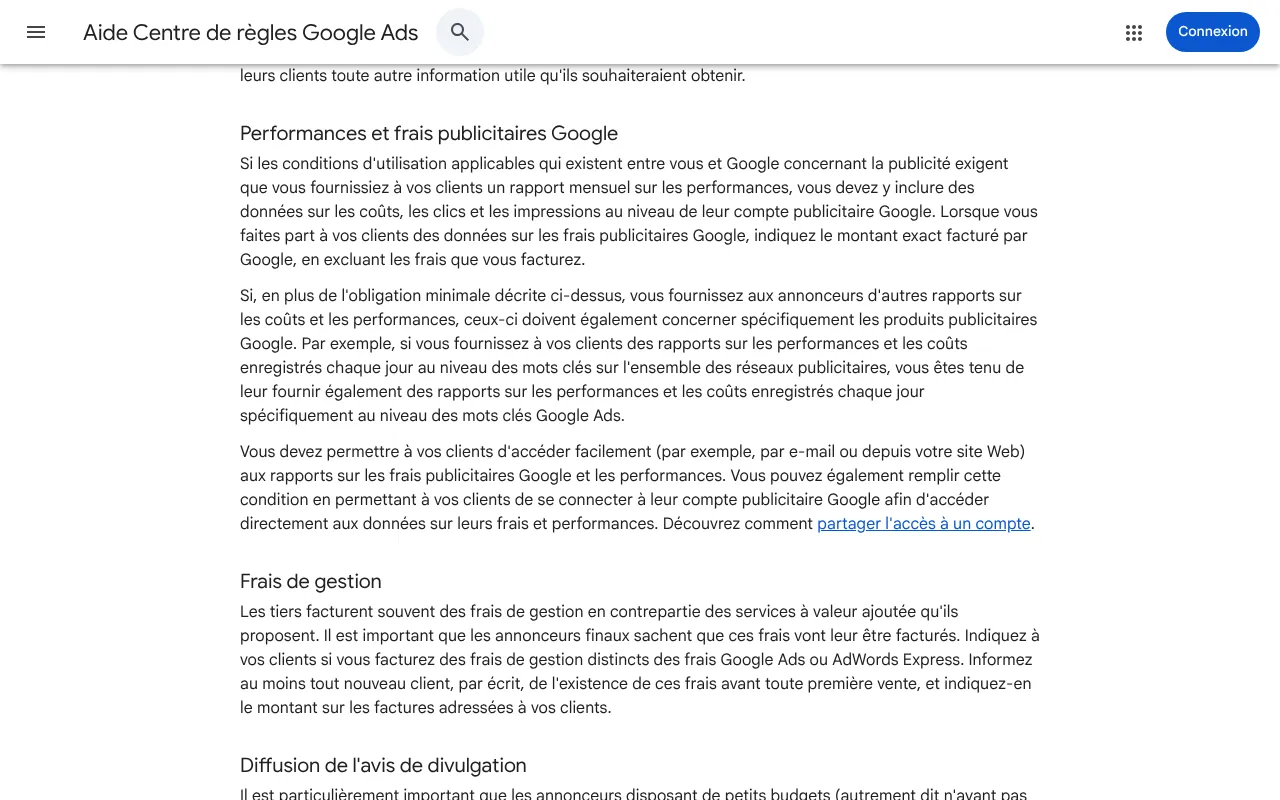
The transparency requirements of Google’s third-party policy (French version shown): reporting on cost, clicks and impressions, the exact amount charged by Google, management fees disclosed in writing. Captured on 19 October 2026.
In practice, this policy asks the agency, among other things:
- to report the exact amount charged by Google, excluding its own fees, when it reports spend to you;
- to tell you in writing, before the first sale, whether it charges management fees, and to show the amount on its invoices;
- to give you your Google Ads customer ID if you ask;
- to use a separate account for each advertiser.
The same text forbids certain promises: guaranteeing top placement, claiming ads will always show, offering unlimited clicks. A sales proposal containing one of them tells you something about the agency before you even sign.
1. The account belongs to you
This is the clause that matters most on the day you leave. Google requires one account per advertiser because Quality Score is fundamentally based on account history; that history has value, and it should stay with you.
- The account is created in your name, with your payments profile, and you are an administrator. The agency accesses it through its manager account, with an access level you can revoke.
- The other assets follow the same rule: analytics property, tag container, conversion actions, audience lists, product feeds. They are created on your side and shared with the agency.
- The creative is yours: copy, visuals and videos produced for your campaigns.
Watch out
The account opened by the agency
An account created inside the agency’s organisation, paid by it and re-invoiced, looks simpler at the start. When you leave, you risk starting again from an empty account: no history, no lists, no conversions. Check who its administrator is before the first euro is spent.
2. Money, in two lines
The contract separates ad spend, paid to Google, from the agency’s fee. The common models each have their bias, and none is bad in itself:
- a monthly flat fee: predictable, independent of spend, but to revisit if the account grows;
- a percentage of ad spend: follows the workload, but pays more when more is spent;
- a flat fee plus a percentage above a threshold: a common compromise.
For our part, the ad budget in our digital marketing offer is paid directly to Google, never through us, and management costs €1,500 per month at minimum, then 10% of the ad budget once it exceeds €15,000 per month. Whatever the model, the contract says what is included (creative, pages, measurement) and what is billed separately.
3. What the agency delivers
A campaign nobody looks at spends whatever it is given. The contract therefore names the work, not just the result:
- every week: reading the search terms and adding negative keywords, checking the enquiries received;
- every month: a report with cost, clicks, impressions and conversions, plus what was changed and why;
- continuously: a dated change log you can consult;
- before anything runs: a review of copy and images, including those generated by AI on the platform or agency side.
The monthly report should talk about your business, not only the platform. Automated assets deserve their own line: with Performance Max, ask for the pages Google chose, the search terms and the share of your own brand.
4. Success criteria
Judged on clicks, an agency optimises clicks. Judged on submitted enquiries, it optimises forms. The contract sets the criterion that pays you:
From the easy criterion to the useful one
- Clicks
Easy to get, with no reliable link to sales.
- Enquiries
Better, but a form is not a project.
- Qualified enquiries
Judged by a written rule, applied in your CRM.
- Customer acquisition cost
What a signed customer costs, agency fees included.
Aiming at the last two requires the agency to see what becomes of each enquiry: our guide to sending CRM sales back to Google Ads describes the setup, and our article on customer acquisition cost shows how to calculate it. Conversely, be wary of a numerical result promised before any audit: nobody knows your enquiry rate before measuring it.
Measurement itself is checked at the start, not at the first report. Palmora Property, a real-estate listings site we work with, learned this during its tracking audit: the tag container held one tag and zero events. An agency steering on that data would have produced meaningless reports.
5. Term, notice and exit
- A realistic ramp-up period: a B2B account is judged over at least one sales cycle, as our article on the minimum budget that gives a signal explains.
- Short notice afterwards, rather than a long commitment that renews automatically.
- A planned handover: removal of the agency’s access, export of reports and change log, delivery of creative and lists.
- No penalty attached to the account: it is already yours.
Key takeaway
In France, the contract also has a legal framework
When an intermediary buys advertising space for an advertiser in France, the 1993 Sapin law requires a mandate contract, and the 2015 Macron law clarified that this obligation applies to any medium, the internet included. If the agency pays Google and re-invoices you, have the contract reviewed by a lawyer.
The contract checklist
- The account.
In your name, your payment method, you as administrator; the agency invited.
- The money.
Ad spend and fee separate, model and inclusions in writing.
- The deliverables.
Weekly routine, monthly report, change log, review before anything runs.
- The criterion.
Qualified enquiries or acquisition cost, with the measurement that makes it possible.
- The exit.
Notice, return of access, data and creative.
The same questions apply to other platforms: customer lists and audiences (retargeting without third-party cookies), channel choice (Google Ads or Meta, LinkedIn Ads), and new placements such as ads in AI answers. Ask also who checks the landing page: an agency that only touches the ads solves half the problem. And if the agency generates ads with AI, reviewing the promises is not a detail, as our article on AI and disinformation reminds us.
Frequently asked questions
Who should own the Google Ads account?
The advertiser. The account is created in their name, with their payments profile, and they keep administrator access; the agency is invited. Google requires a separate account for each advertiser, and account history weighs on Quality Score: keeping it on your side avoids starting from scratch when you change agency.
How much does a Google Ads agency cost?
The common models are a monthly flat fee, a percentage of ad spend, or a mix of both. Google requires agencies to disclose their management fees in writing before the first sale and to show them on their invoices. Compare offers on the same scope: are creative, pages and measurement included?
Can an agency guarantee results on Google Ads?
It cannot guarantee top placement or that ads will always show: Google’s third-party policy forbids those promises. A commitment to the work (routine, reports, tests) and a jointly tracked result criterion, such as cost per qualified enquiry, are more honest than a figure promised before any audit.
How do you get your account back when leaving an agency?
If the account is in your name and you are an administrator, you simply remove the agency’s access. Otherwise, ask it to transfer administrator rights to you before the contract ends, with an export of reports, lists and creative. That is why the exit clause is written at signature.
Sources
- Google Ads policy, Google third-party policy (new tab)support.google.com
- CMS Francis Lefebvre, Publicité : l’instauration de mesures de transparence (new tab)cms.law
CMS Francis Lefebvre, Publicité : l’instauration de mesures de transparence
Read on cms.law(new tab)Jim · founder of Brain Plus AI
Also in online advertising

Choose and price7 min
Google Ads in B2B: the minimum budget that gives a signal
In B2B, a Google Ads budget that is too small does not just cost little: it tells you nothing. The right minimum comes from your click price, your enquiry rate and the number of enquiries you need to judge.

Practical guide6 min
Negative keywords: the fastest saving in Google Ads
Every search unrelated to your offer that triggers a click gets paid for. Negative keywords cut that spend in a few minutes a week, provided you read the real searches and know three of Google's rules.

Practical guide8 min
Send your CRM sales back to Google Ads: the guide
In B2B, the sale is signed weeks after the click, by phone or in a meeting. Until Google Ads knows that, it optimises for submitted forms, not for customers: here is how to send it the stages from your CRM.