Contents7
- 01The cases in one timeline
- 02Germany: memorisation condemned, dataset upheld
- 03European Union: a first case before the Court of Justice
- 04France: the presumption of use awaits MPs
- 05United Kingdom and United States: two other approaches
- 06What it changes for those who publish, and those who generate
- 07Frequently asked questions
On 31 July 2026, the Munich I Regional Court largely ruled for GEMA, the German music rights society, against Suno, an AI music generator. It was the second ruling from that chamber against an AI provider in nine months, after OpenAI in November 2025. Meanwhile the EU Court of Justice, US judges and the French Parliament are moving, each at its own pace, on the same question.
This briefing from our SEO and AI visibility section takes stock as of 20 October 2026. It is not legal advice: a pending case can turn on appeal, and your counsel remains the reference for a specific situation. The underlying debate, whether authors should be paid, is covered in our analysis of AI and copyright.
In short
In Germany, two non-final rulings found against OpenAI and then Suno over works memorised or reproduced by their models, and an appeal court upheld the creation of an AI training dataset.
The EU Court of Justice held its first hearing on generative AI and copyright on 10 March 2026; the Advocate General’s opinion, expected on 3 September, had not been published as far as we know on 20 October.
In France, the presumption that AI providers used protected works, passed by the Senate on 8 April 2026, was adopted in committee at the National Assembly on 2 June and awaits the floor.
In the United States, training was held to be fair use in two cases in 2025, but downloading pirated libraries was not, which cost Anthropic 1.5 billion dollars.
The cases in one timeline
- 6 March 2025
In France, three authors’ and publishers’ organisations sue Meta before the Paris Judicial Court over the training of Llama.
- 3 April 2025
A Hungarian court refers the Like Company v Google case to the EU Court of Justice.
- June 2025
Two California judges hold that training on books is fair use, in the cases against Anthropic and Meta.
- 4 November 2025
The High Court in London dismisses most of Getty Images’ claims against Stability AI.
- 11 November 2025
The Munich I Regional Court rules for GEMA against OpenAI.
- December 2025
The Hamburg Higher Regional Court upholds the lawfulness of LAION’s dataset.
- 10 March 2026
First Court of Justice hearing on generative AI and copyright.
- 8 April 2026
The French Senate passes the presumption of use of cultural content.
- 2 June 2026
The National Assembly’s cultural affairs committee adopts the text.
- 20 July 2026
A federal judge approves the 1.5 billion dollar settlement between Anthropic and authors.
- 31 July 2026
The Munich I Regional Court rules for GEMA against Suno.
Germany: memorisation condemned, dataset upheld
In GEMA v OpenAI (42 O 14139/24), the Munich court held that the lyrics of nine German songs, memorised in the models’ parameters, were an unauthorised reproduction of them, and that outputting them in ChatGPT’s answers was another, reports Conventus Law. The court accepts that training generally falls under the text and data mining exception, but not the memorisation of specific works. OpenAI appealed; the case is pending before the Munich Court of Appeal, according to law firm Reed Smith.
On 31 July 2026, the same chamber decided GEMA v Suno (42 O 763/25). According to Reed Smith, it found that memorising works in models hosted on German servers was an infringing reproduction, that Suno, not its users, was liable for the outputs, and that complying with the AI Act does not release a provider from copyright liability. We read this ruling through Reed Smith’s account, not in its full text, and it is not final: Suno may appeal, and the court of appeal may decide otherwise, as it will for OpenAI.
Kneschke v LAION points the other way, on a different issue. In December 2025, the Hamburg Higher Regional Court (5 U 104/24) held that building an AI training dataset fell under the text and data mining exceptions, explains law firm Freshfields. The photographer’s reservation, written in natural language, was not found to be machine-readable at the time of the download, in 2021. A further appeal to the Federal Court of Justice has been allowed.
European Union: a first case before the Court of Justice
Like Company v Google (C-250/25) was brought by a Hungarian press publisher, which says the Gemini chatbot displayed large extracts of its articles and was trained on them without permission. The Budapest court asks four questions, summarised by law firm Stephenson Harwood: is displaying partly identical text a communication to the public, is training a reproduction, does the text and data mining exception cover it, and is an answer generated at a user’s request attributable to the provider?
The hearing took place on 10 March 2026, and the Advocate General’s opinion was expected on 3 September 2026, according to the European IP Helpdesk. As of 21 September, no opinion had been delivered, according to EU Law Radar, and we found no trace of one on 20 October. In our estimate, a judgment is unlikely before 2027. It will bind every court in the Union, including the appeal in Munich.
France: the presumption of use awaits MPs
The bill tabled in the Senate on 12 December 2025 creates a presumption: a protected work would be deemed used by an AI system as soon as an indication linked to its development, deployment or output makes that use plausible, summarises law firm Delsol. The burden of proof would shift to the provider.
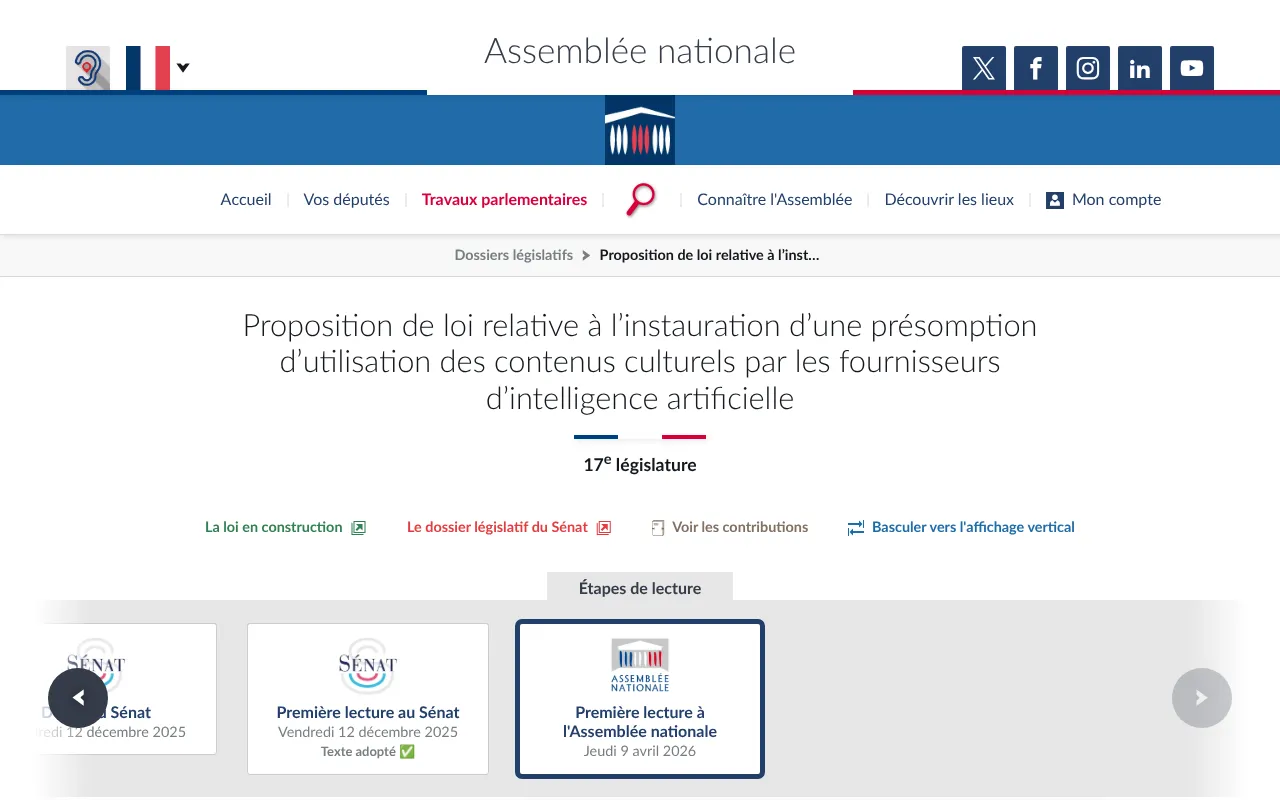
The National Assembly’s file: the text has been at first reading before MPs since 9 April 2026. Under the Senate reading, the page shows the filing date, while the adoption dates from 8 April. Captured on 20 October 2026.
The Council of State found that the national legislature had the power to create this presumption, the Senate announced on 23 March 2026. Senators passed the text on 8 April; the National Assembly’s cultural affairs committee adopted it in turn on 2 June, according to the legislative file. It now has to be debated on the floor, with no date published as of 20 October.
In the courts, the March 2025 lawsuit against Meta by the French publishers’ association, the authors’ society SGDL and the authors’ and composers’ union SNAC is still pending according to the CMS case tracker; we found no published decision.
United Kingdom and United States: two other approaches
In London, the High Court dismissed most of Getty Images’ case against Stability AI on 4 November 2025: the model weights do not store the works and are therefore not an “infringing copy”, according to law firm Latham & Watkins. Getty was granted permission to appeal. The British policy context, with no exception for commercial training, is covered in our briefing on the United Kingdom.
In the United States, two California judges held in June 2025 that training models on books was fair use, but one of them refused that finding for building a library from pirated copies, recalls law firm White & Case. That case, Bartz v Anthropic, ended in a settlement approved on 20 July 2026:
in settlement between Anthropic and authors, approved by the federal court for Northern California
or so per work, according to the estimate accepted by the court
What it changes for those who publish, and those who generate
For a business that publishes content, the most concrete lesson comes from Hamburg: an objection to the mining of your texts only counts if a machine can read it. A sentence in your legal notice may not be enough; a robots.txt naming the AI crawlers is the most common method. You still need to know what your site actually serves.
From the field
The file served was not the one we thought
During an SEO and GEO audit on 22 July 2026 (internal finding, recorded on the audited site on that date), the robots.txt actually served started with a block added by the CDN, absent from the code, which already disallowed GPTBot, ClaudeBot, Google-Extended, meta-externalagent and several other AI crawlers. Nobody had decided it. A machine-readable objection can exist without you choosing it, or be missing when you believe it is in place.
The choice itself, objecting or letting crawlers read you to get cited, is made crawler by crawler: we discuss the trade-offs in how to get cited by ChatGPT, what an llms.txt file is for and Meta’s terms on crawling websites.
For a business that generates content, the Munich rulings place liability for outputs on the model provider, not on the user asking the question. Publishing a text or image that reproduces a work is still your publication, though: the human review before going live that we argue for in should you disclose AI-written text serves that purpose too. None of these decisions singles out one AI provider as safer than the others: they all concern uses, not brands.
The regulatory deadlines around these cases, including the obligation for model providers to respect objections, are in our digital regulation calendar. Checking what your site actually allows AI crawlers and deciding what it should show them is the scope of our SEO and GEO offer, and it is part of what an SEO agency should deliver in the AI era.
Frequently asked questions
Has a European court already ruled against an AI for copyright infringement?
Yes, at first instance: the Munich I Regional Court ruled for GEMA against OpenAI on 11 November 2025, then against Suno on 31 July 2026, over works memorised and reproduced by their models. Neither ruling is final: OpenAI has appealed, and Suno can.
Can you stop an AI from training on your website?
In Europe, the 2019 directive lets rights holders object to the mining of their content, expressed in an appropriate manner, notably by machine-readable means for content online. The Hamburg appeal court set aside a reservation written in natural language. The robots.txt file is the most common method, crawler by crawler.
Is the French presumption of use by AI in force?
No. The bill was passed by the Senate on 8 April 2026 and by the National Assembly’s cultural affairs committee on 2 June 2026, but MPs still have to vote on it on the floor. As of 20 October 2026, no date for the debate had been published.
When will the EU Court of Justice decide Like Company v Google?
Probably not before 2027. The hearing took place on 10 March 2026; the Advocate General’s opinion, expected on 3 September 2026, had not been published as far as we know on 20 October. The judgment will apply to every court in the Union.
Sources
- Conventus Law (new tab)conventuslaw.com
- Law firm Reed Smith (new tab)reedsmith.com
- Law firm Freshfields (new tab)freshfields.com
- Law firm Stephenson Harwood (new tab)stephensonharwood.com
- The European IP Helpdesk (new tab)intellectual-property-helpdesk.ec.europa.eu
- EU Law Radar (new tab)eulawradar.com
- Law firm Delsol (new tab)delsolavocats.com
- The Senate announced (new tab)senat.fr
- The legislative file (new tab)assemblee-nationale.fr
- The CMS case tracker (new tab)cms.law
- Law firm Latham & Watkins (new tab)lw.com
- Law firm White & Case (new tab)whitecase.com
Jim · founder of Brain Plus AI
Also in seo and ai visibility

Understand9 min
AI Act and digital rules calendar: deadlines 2026 to 2028
AI Act, Data Act, Cyber Resilience Act, NIS2, e-invoicing in France and the first US state laws: every date that matters for a business, from autumn 2026 to August 2028, on one page kept up to date. For each deadline, who is covered and what to prepare.

Stepping back7 min
AI and copyright: should authors be paid?
Plundering works, or learning like a reader? European law and a first German ruling are starting to separate learning from memorising, and a content publisher can already choose to opt out of training.
Practical guide7 min
How to get cited by ChatGPT and AI search engines
What actually gets a site cited by ChatGPT, Claude or Perplexity: let the bots read it, answer straight away, source every fact, mark up only what is shown. And how to measure it without fooling yourself.