
Contents6
On 30 October 2026, a new version of Meta’s commercial terms takes effect for every business that uses its professional tools: pages, ads, the business dashboard. In mid-October, lawyers read a clause in it that lets Meta crawl the websites linked to these accounts and use their content to train its products. On 17 October, the press reported that it had been removed; the next day, the preview of the terms still contained it.
This post from our SEO and GEO section takes stock on 19 October 2026. It is not legal advice: if your website’s content is your product (news, research, training), have the terms read by a lawyer.
In short
The version published in mid-October authorises Meta to send crawlers to websites “associated with your products or services” and to use that content to train its products.
On 17 October, Meta said these crawling rules only applied to its advertising and business products; the preview read on 18 October still contained the sentence.
Continuing to use Meta’s tools after 30 October counts as accepting the terms.
What you control: the text you accept, and the robots.txt file your website actually serves, crawler by crawler.
What do Meta’s new commercial terms say?
The previous version of the commercial terms, dated 6 March 2024, contained no crawling clause. The version that applies from 30 October 2026 adds one in its section 1: the business authorises Meta, or any entity acting on its behalf, to use automated software (bots, spiders, user agents) to access domains, pages or URLs “associated with your products or services”, to create test credentials to access them, and to pull regular updates from them, according to PPC Land’s analysis of the text. The next sentence is the one that drew attention:
Meta may use any content from such domains, web pages or URLs to provide, develop, improve, research, train and maintain the integrity of [its products].
Three legal experts interviewed by Nieman Lab, including James Grimmelmann (Cornell) and attorney Matt Topic, saw in it a way for Meta to argue that this contract overrides the blocks in a robots.txt file, and in the test credentials a way to get past a registration wall. Matt Topic sums it up: nothing says a court would enforce the clause, but publishers should assume it would.
What changed on 17 October?
The sequence fits in two weeks, and it is not over:
- 6 March 2024
Previous version of the commercial terms, with no crawling clause.
- 15 October 2026
Nieman Lab publishes the reading of three legal experts.
- 16 October 2026
Andy Stone, a Meta spokesperson, calls these readings “false” and says nothing changes in how Meta uses web crawlers.
- 17 October 2026
The press reports that the sentence has disappeared from the terms page; Meta says these rules only applied to its advertising and business products, and that it clarified this in the text.
- 18 October 2026
The British English preview, read by PPC Land, still contains the sentence, without the announced limitation.
- 30 October 2026
The new terms take effect.
The sources: TechCrunch for the removal and Meta’s statement, PPC Land for the 18 October preview. PPC Land says it does not know which version other journalists consulted, nor whether the change applies in every language and region. Hence the only safe rule: read the version that your own account asks you to accept.
Is your business affected?
Yes, if it has a business account with Meta: a Facebook or Instagram page managed as a business, ad campaigns, a catalogue or the business dashboard. Section 7 of the terms provides that commercial use of Meta’s products after notice counts as acceptance; the alternative offered is to stop that use. There is no box to untick.
What the clause covers exactly is still debated. Meta talks about retrieving accurate information on products sold on third-party websites, which serves its ads; the sentence on training goes further. For an online shop, letting Meta read its product pages may help its campaigns. For a publisher whose articles are the product, the question is the one of AI companies paying authors.
What can you check before 30 October?
The contract is one thing, technical access is another. Meta documents its web crawlers and how to set them in the robots.txt file:
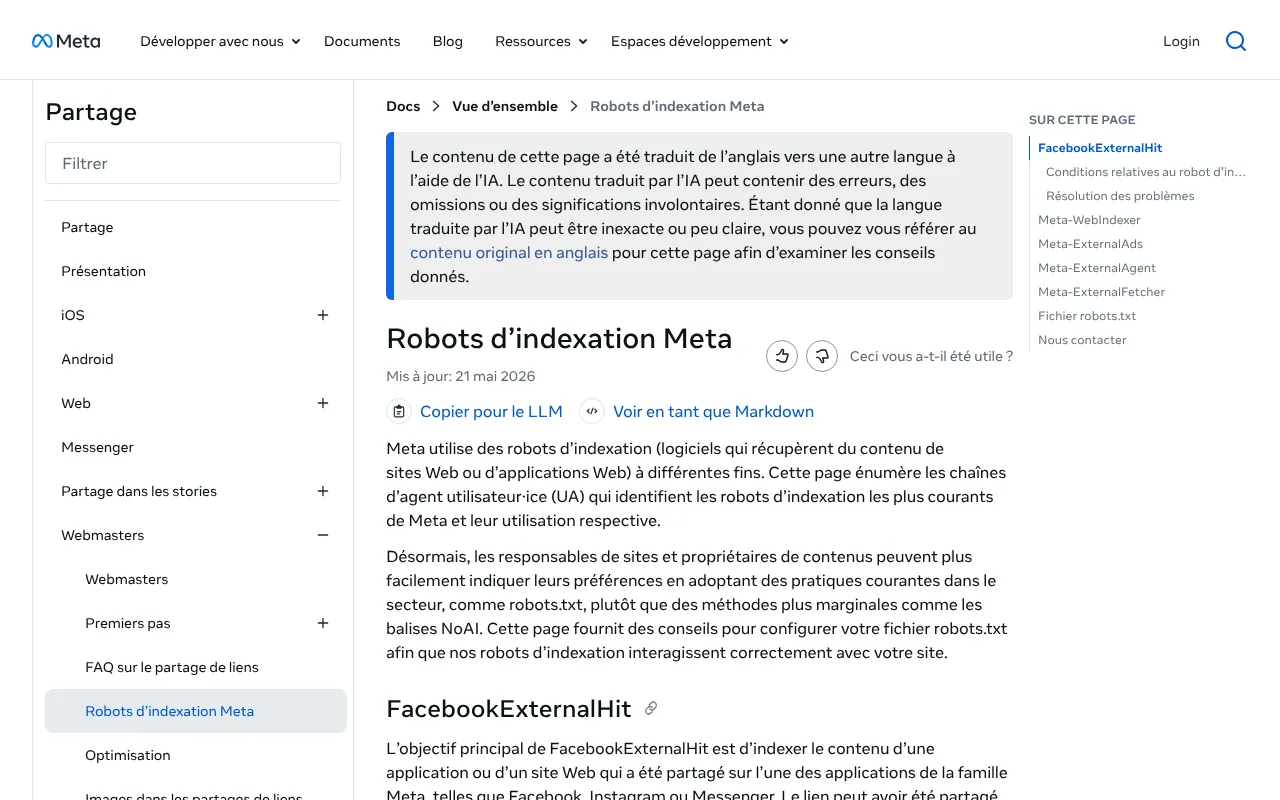
The page where Meta lists its crawlers and how to handle them in robots.txt (French edition). Captured on 19 October 2026.
Five crawlers, five uses, according to that page:
- FacebookExternalHit: it builds the preview of a shared link; it may ignore robots.txt for security or integrity checks.
- Meta-WebIndexer: it serves Meta AI search, to cite your pages with a link.
- Meta-ExternalAds: it serves advertising and business products.
- Meta-ExternalAgent: it is used to train Meta’s foundation models, and to index content.
- Meta-ExternalFetcher: it fetches a link at a user’s request; it may also ignore robots.txt.
Meta notes that a robots.txt change can take up to 24 hours to be picked up. So the useful move is not to close everything: it is to decide, crawler by crawler, what you open to advertising, to citation and to training, as with the OpenAI, Google or Anthropic crawlers we cover in how to get cited by ChatGPT. The llms.txt file settles none of this, as our article on llms.txt explains.
From the field
A client learned this the hard way: during the SEO and GEO audit of its website on 22 July 2026, the robots.txt actually served started with a block added by its CDN, absent from the code, which already shut the site to meta-externalagent, GPTBot, ClaudeBot, Google-Extended and several other AI crawlers. Nobody had decided it. What you think you wrote and what crawlers read can differ.
Four checks before 30 October:
- Read the text you accept.
Open the terms from your business account and keep a dated copy.
- Read the robots.txt you serve.
The one at the public address, CDN included, not the one in the repository.
- Decide crawler by crawler.
Advertising, citation, training: three separate decisions, to write into your policy.
- Get legal advice if content is your product.
A publisher, a training provider or a research firm has good reason to.
What it changes for a team of 20 to 500 people
Nothing urgent if your website is a showcase you want seen everywhere; a real trade-off if your pages sell knowledge. Either way, the decision belongs to the managing director or the marketing lead, not to a CDN default setting. It is one of the first checks a serious audit makes, as what an AI SEO agency should deliver details. Our offer to get found on Google and cited by AI starts there.
It is not the only text moving this autumn. Our October AI news for leaders puts it among the month’s other facts, and three deadlines follow: marking AI-generated images by 2 December 2026, the timetable revised by the Digital Omnibus in the AI Act, and on the cybersecurity side NIS2, still waiting for its French law.
Frequently asked questions
Can Meta legally use my website to train its AI?
The clause published in mid-October provides for it for websites linked to a business account, but its exact scope and its validity under European law are not settled. In Europe, a rights holder can reserve its content against text and data mining by machine-readable means, including robots.txt. For high-value content, get legal advice before 30 October.
Does blocking Meta-ExternalAgent remove me from Facebook?
No, according to Meta’s documentation. Previews of shared links come from FacebookExternalHit, advertising from Meta-ExternalAds and Meta AI search from Meta-WebIndexer. Blocking the training crawler therefore does not affect those uses. Still check, after the change, that your shared links keep showing their preview.
Was the sentence on training really removed?
On 19 October 2026, the sources disagree. TechCrunch reports its removal on 17 October and Meta’s clarification about advertising products; PPC Land read the preview on the 18th and still found the sentence. Only the version shown in your account counts: read it before 30 October and keep a copy.
Can I refuse Meta’s new terms?
Not while keeping the tools. The terms provide that commercial use after notice counts as acceptance, and that a business that refuses may stop using Meta’s products for business purposes. There is no middle option. Your real room for manoeuvre is technical: your website’s robots.txt, crawler by crawler.
Sources
- PPC Land’s analysis of the text (new tab)ppc.land
- TechCrunch for the removal and Meta’s statement (new tab)techcrunch.com
- Documents its web crawlers (new tab)developers.facebook.com
Jim · founder of Brain Plus AI
Also in seo and ai visibility

Understand6 min
llms.txt: what it is really for
The llms.txt file promises to help AI read your site. What the proposal says, what can be verified about real usage, what Google, OpenAI and Anthropic say about it, and why we publish one anyway.

Stepping back7 min
AI and copyright: should authors be paid?
Plundering works, or learning like a reader? European law and a first German ruling are starting to separate learning from memorising, and a content publisher can already choose to opt out of training.

Understand7 min
AI news for leaders, October 2026: what changes
New models from Mistral and Google, a well-known software company switching provider, websites closing the door to agents, a French study on hiring young people and a cyber law postponed again. The facts of October 2026, and what each one changes for a business.