
Contents5
On 18 March 2026, the UK government published its report on copyright and artificial intelligence, which the Data (Use and Access) Act 2025 required it to deliver. Its conclusion fits in one sentence: the AI training exception with an opt-out, which it had backed since late 2024, is no longer its preferred route, and it proposes no other. Seven months and one change of Prime Minister later, the law has not moved.
This briefing from our SEO and AI visibility section is up to date as of 20 October 2026. It is not legal advice: UK law differs from EU law, and a lawyer who practises it has the final say on a specific case.
In short
The UK has no general AI law, and none was announced in the King’s Speech of 13 May 2026.
Its only text and data mining exception is limited to non-commercial research: commercial training in principle requires the rights holders’ permission.
The 18 March 2026 report drops the opt-out exception, with no other reform, and leaves the licensing market to develop.
Andy Burnham, Prime Minister since 20 July 2026, has not yet set a new line; Getty Images’ appeal against Stability AI is not expected to be decided before 2027.
What the report of 18 March 2026 says
The report and its impact assessment were published by the Department for Science, Innovation and Technology, the Department for Culture, Media and Sport and the Intellectual Property Office, under sections 135 and 136 of the Data (Use and Access) Act 2025.
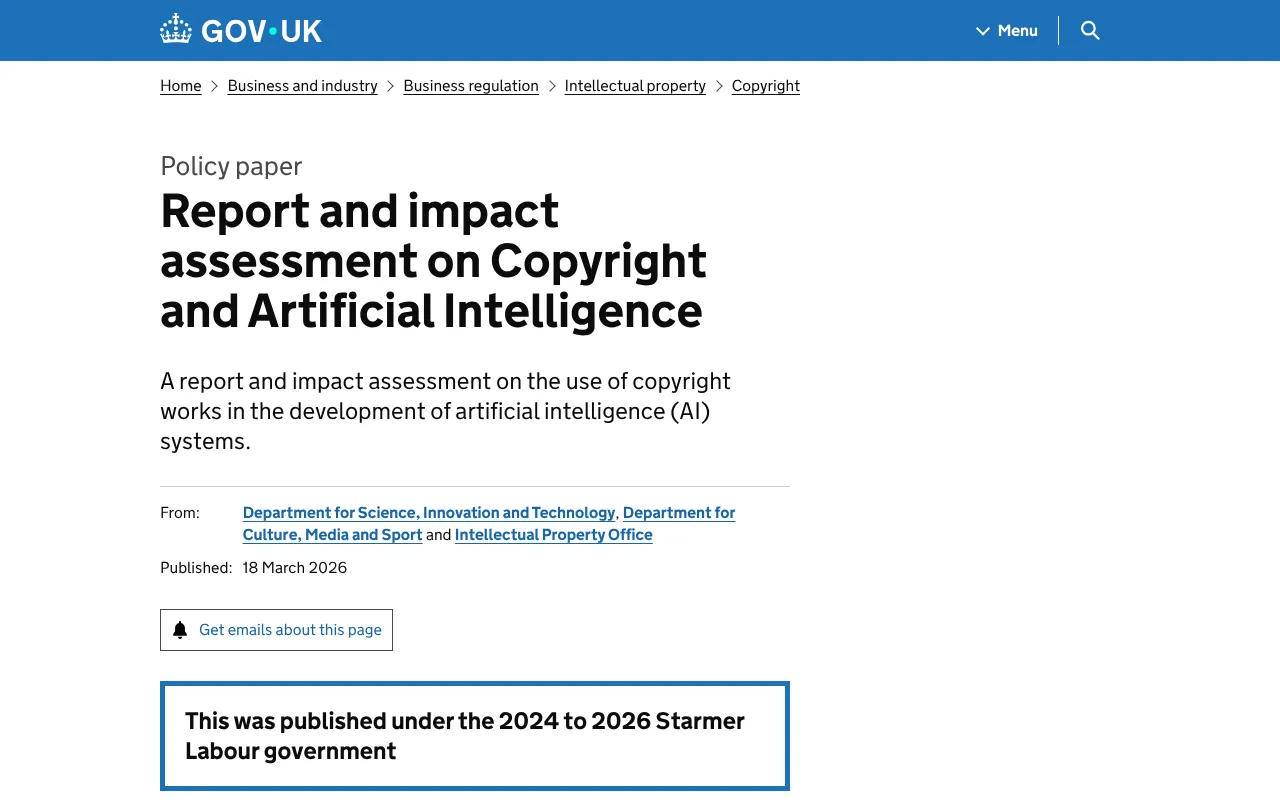
The report’s page on gov.uk, published on 18 March 2026 by three departments. It now carries the notice “published under the 2024 to 2026 Starmer Labour government”. Captured on 20 October 2026.
It follows a consultation launched in December 2024, which received over 11,500 responses, recalls law firm Osborne Clarke. The option favoured at the time, a broad commercial mining exception with a rights holder opt-out, close to the EU model, ran into strong opposition from creators and the creative industries.
No longer the government’s preferred way forward.
For the rest, the report chooses monitoring over legislation, according to the analysis by law firm Linklaters:
- Transparency: over 90% of respondents wanted AI developers to disclose their training sources; the government will only monitor foreign rules and encourage best practice.
- Licensing: no intervention, payment remains a commercial negotiation; the government supports the pilot of a marketplace, the Creative Content Exchange.
- Computer-generated works: their special protection, rare worldwide, could be removed for lack of evidence that it is useful; this is the clearest reform signal.
- Digital replicas: no general personality right in the UK, options under study, no commitment.
In May 2026, the government added that AI developers must seek permission and acquire licences to use protected works, reports law firm Reed Smith. We know this statement only through that account: we have not found the government text itself, and a policy position is not a rule of law. The same month, the King’s Speech of 13 May announced no AI bill, despite Labour’s 2024 manifesto commitment on the most powerful models.
Since July: a new Prime Minister, the same law
Andy Burnham succeeded Keir Starmer on 20 July 2026, AP reports. He has not yet clearly set out his policy on AI and copyright, notes law firm Lewis Silkin on 8 October 2026. A minister responsible for intellectual property, Chris McDonald, was confirmed in late August, and the consultation on digital replicas, expected last summer, remains uncertain.
The Prime Minister convened a Creative Industries AI Summit in Manchester for 9 October 2026. It was meant to close with “Manchester Principles”, a draft framework built on rights holder permission for training, attribution of the content used, and proportionate remedies. As of 20 October, we found no final version published: it is a political commitment, not a rule of law.
In the courts, the question of models trained abroad and then used in the UK remains open. In November 2025, the High Court held that the Stable Diffusion weights were not an infringing copy of Getty’s images; that ruling is not final, since Getty appealed, and Lewis Silkin does not expect a decision before 2027. The details of that case, with the European and American cases, are in our briefing on AI copyright cases.
Europe, UK, United States: three regimes for training
For a business publishing in several countries, the same content falls under three logics:
- European Union: text and data mining is allowed, including for commercial purposes, unless the rights holder has opted out in a machine-readable way; since 2 August 2025, the AI Act requires providers of general-purpose models to respect that opt-out and publish a summary of their training data.
- United Kingdom: the exception only covers non-commercial research; commercial training in principle requires a licence, with no opt-out mechanism in the law, since there is no exception to opt out of.
- United States: no written exception, but “fair use” assessed case by case; two judges accepted it in 2025 for training on books, not for pirated copies.
Key takeaway
In the UK, silence does not mean permission: with no commercial exception, it is up to the developer to obtain a licence, not up to the rights holder to object. Robots.txt still plays its practical role, since it is what crawlers read.
What it changes for a business publishing in English
If you publish for UK readers, three concrete consequences.
Your technical choice stays the same. AI crawlers do not read your jurisdiction, they read your robots.txt. Letting them read you so you get cited in assistants’ answers, or closing the door to training: the decision is made crawler by crawler, as we explain in how to get cited by ChatGPT, and the underlying debate on payment is in should authors be paid.
Your generated content is less certain to be protected. If the UK removes protection for computer-generated works, a text or image produced without real human input could belong to no one. Review and rewriting by a person, useful for quality, become useful for ownership too.
One more market means more rules. Opening an English-speaking market is also prepared on this front, like the rest of the approach described in our international SEO guide.
From the field
On this blog, every generated article starts as a draft and is only published after human review: that is what turns a text produced with AI into a text someone answers for. On Palmora Property, a property portal published in six languages, the translation pipeline moved from DeepL to Gemini: cost divided by 60, and 95% of segments come from the cache after the first run (internal measurement, on our own pipeline for this client, taken in August 2026; not a promise for another site). Publishing in English costs little; knowing which rules you publish under takes more care.
The European deadlines that frame model training are in our digital regulation calendar. Deciding what your site shows AI crawlers market by market is the scope of our SEO and GEO offer, and one of the items of what an SEO agency should deliver in the AI era.
Frequently asked questions
Does the UK allow AI training on copyrighted works?
Not for commercial purposes without permission: the only UK text and data mining exception covers non-commercial research. In March 2026 the government gave up on creating a commercial exception with an opt-out, and considers, according to a May 2026 statement reported by law firm Reed Smith, that developers must obtain licences from the rights holders whose works they use.
Does the UK have an AI law like the EU AI Act?
No. No general AI statute is in force, and the King’s Speech of 13 May 2026, which sets the legislative programme, announced none. AI there falls under existing laws, including copyright, data protection and consumer law, applied sector by sector.
Has the Burnham government changed policy on AI and copyright?
Not in law as of 20 October 2026. Andy Burnham convened a creative industries summit on 9 October meant to produce “Manchester Principles” built on rights holder permission, but no copyright reform has been tabled in Parliament and the law is unchanged.
Does a robots.txt protect my site in the UK?
It remains the signal that crawlers read, so it is the practical way to say no. Legally, the UK logic is the reverse of the EU one: with no commercial exception, it is up to the developer to obtain a licence, whether or not you have written an objection.
Sources
- Law firm Osborne Clarke (new tab)osborneclarke.com
- The analysis by law firm Linklaters (new tab)linklaters.com
- Law firm Reed Smith (new tab)reedsmith.com
- No AI bill (new tab)iapp.org
- AP reports (new tab)usnews.com
- Law firm Lewis Silkin (new tab)lewissilkin.com
Jim · founder of Brain Plus AI
Also in seo and ai visibility

Understand9 min
AI Act and digital rules calendar: deadlines 2026 to 2028
AI Act, Data Act, Cyber Resilience Act, NIS2, e-invoicing in France and the first US state laws: every date that matters for a business, from autumn 2026 to August 2028, on one page kept up to date. For each deadline, who is covered and what to prepare.

Stepping back7 min
AI and copyright: should authors be paid?
Plundering works, or learning like a reader? European law and a first German ruling are starting to separate learning from memorising, and a content publisher can already choose to opt out of training.
Understand8 min
AI and copyright: where the court cases stand in 2026
Two rulings in Munich, a first case before the EU Court of Justice, a French bill passed by the Senate and a record settlement in the United States: the state of AI copyright litigation as of 20 October 2026, and what it changes for anyone who publishes or generates content.